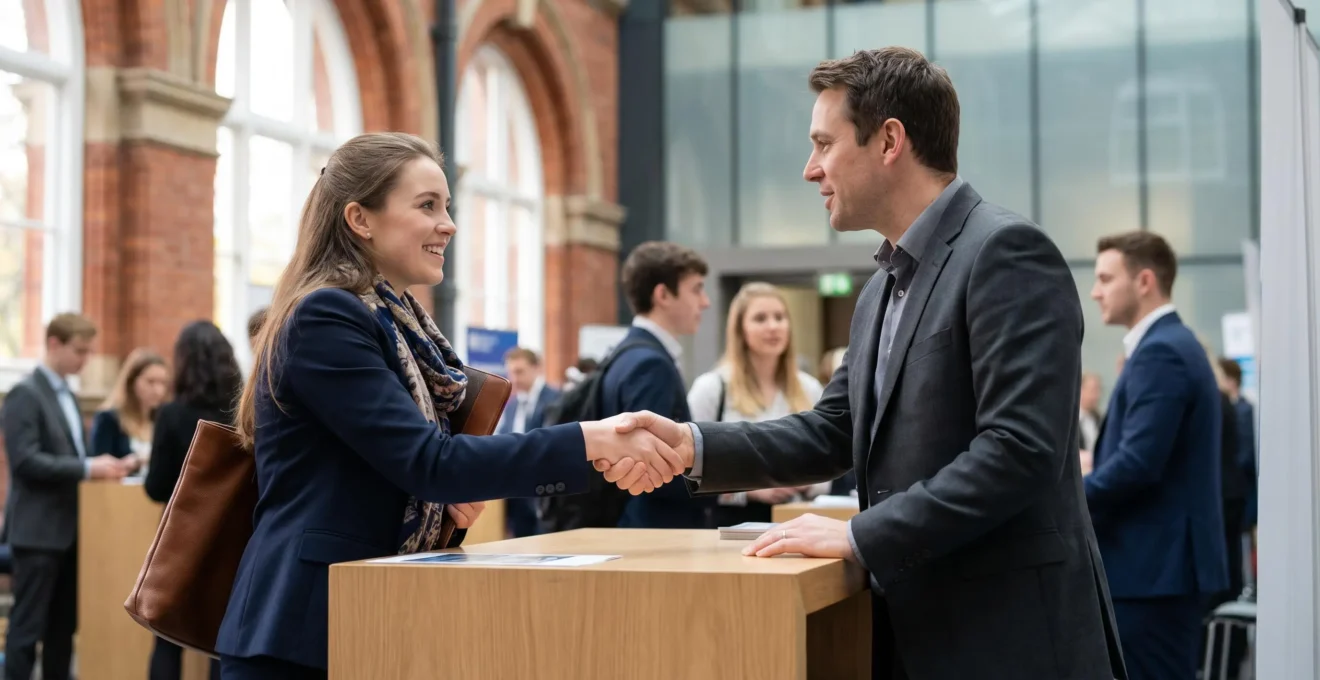
To stand out at a UK grad fair, you must stop trying to impress and start trying to engage a recruiter by solving their problem: finding talent that thinks, not just performs.
- Generic questions like “What does your company do?” signal a lack of preparation and increase a recruiter’s mental fatigue.
- The real opportunities often lie away from the long queues of major corporations, with SMEs that offer greater impact and direct access to leadership.
Recommendation: Shift your mindset from collecting freebies to collecting intelligence. Every interaction is a chance to prove your commercial awareness, not just recite your CV.
The air in a hall like the NEC or ExCeL is thick with a unique blend of ambition and hairspray. Thousands of students, CVs in hand, swarm around brightly lit stalls. From my side of the table, after six hours and hundreds of conversations, it becomes a blur of anxious faces and rehearsed speeches. You’ve been told to do your research, prepare an elevator pitch, and dress smart. That’s the baseline, the absolute minimum. It’s the noise.
Most advice focuses on what you should do. This guide is about why most of it fails and what to do instead. The platitudes you’ve learned are designed to make you look impressive. But after the 50th identical pitch, “impressive” becomes generic. My eyes glaze over. What I’m desperately searching for is a signal—a spark of genuine curiosity, commercial awareness, and a personality that won’t drain the life out of a team meeting. But if the key isn’t a flawless pitch, what is it? It’s about understanding the human on the other side of the desk. It’s about making my job easier, not harder.
This article will deconstruct the typical grad fair experience from a recruiter’s perspective. We’ll explore why your opening line is critical, how to frame your degree (no matter what it is), where the true opportunities are hidden, and how to follow up in a way that doesn’t get you immediately archived. Forget what you think you know about networking; it’s time for a reality check.
To navigate this complex environment effectively, we have structured this guide to give you the insider’s perspective. It breaks down the critical moments of a grad fair and provides actionable strategies to turn them into genuine opportunities.
Contents: A Recruiter’s Playbook for Grad Fair Success
- Why Asking ‘What Does Your Company Do?’ Is the Worst Opener?
- How to Pitch Your Humanities Degree to a Tech Recruiter in 30 Seconds?
- Big 4 Queues vs SME Stalls: Where is the Real Opportunity?
- The Swag Mistake: Collecting Pens Instead of Business Cards
- When to Email the Recruiter You Met: Same Day or Next Week?
- Hard Skills vs Soft Skills: Which Matters More for UK Entry-Level Jobs?
- How to Write a LinkedIn Connection Request That Actually Gets Accepted?
- How to Network with Senior Alumni Without Asking for a Job Directly?
Why Asking ‘What Does Your Company Do?’ Is the Worst Opener?
Let me be blunt. When you approach my stand, wait ten minutes in a queue, and your opening question is “So, what do you guys do?”, a part of my soul withers. It’s not just a bad question; it’s a red flag. It tells me you’ve done zero research and are simply carpet-bombing the event. You’ve just made yourself part of the background noise I’m trained to ignore. The core issue here is a failure to appreciate the concept of recruiter fatigue. We are making hundreds of micro-judgements all day, and our cognitive resources are finite.
When you ask a question that could be answered by the first paragraph of our ‘About Us’ page, you are actively draining that resource. You force me to repeat the same corporate spiel I’ve given 100 times, and I immediately categorize you as unprepared. In fact, research into interview fatigue shows that when recruiters are overwhelmed, their ability to spot top talent diminishes. By asking a lazy question, you’re not just hurting your own chances; you’re contributing to the very problem that could cause a great candidate to be overlooked. Some studies even show that up to 82% of candidates can lose interest in a company due to a poor recruitment experience, which often starts with these low-effort interactions.
Your goal is to reduce my cognitive load. Show me you’re a potential colleague, not another item on my to-do list. The best candidates do this by replacing generic queries with a strategic questioning framework that demonstrates prior engagement and business-minded thinking.
- Research-Based Question: Start by referencing something specific. “I saw your company recently launched Project X. I was curious about how the new agile methodology is impacting the development team’s culture.” This proves you’ve done more than read the banner.
- Strategic Question: Ask about the business. “What are the biggest challenges your team is facing in the shift towards sustainable packaging?” This shows you think about company problems, not just job titles.
- Cultural/Personal Question: Build a real connection. “What’s been the most surprising thing for you about working here since you joined?” This is human, memorable, and gives you real insight.
How to Pitch Your Humanities Degree to a Tech Recruiter in 30 Seconds?
A history student approaches my tech company stall, looking apologetic. “I know this is a long shot,” they begin, “but I’m really interested in tech.” This is a common and self-defeating pitch. Stop apologising for your degree. As a recruiter, I’m not hiring a degree; I’m hiring a brain. The problem isn’t your humanities background; it’s your inability to translate its value into the language of my industry. You haven’t connected the dots for me, and in the 30 seconds I have, I’m not going to do it for you.
The key is to stop talking about the *subject* of your essays on 18th-century poetry and start talking about the *skills* you used to produce them. Did you analyse complex, ambiguous texts? That’s critical thinking. Did you construct a compelling argument from disparate sources? That’s data synthesis and storytelling. Did you have to persuade a skeptical professor of your interpretation? That’s stakeholder management. These are the skills that build great products, manage teams, and sell to clients. Your task is to be the bridge between your world and mine.
This isn’t just a theory; it’s a proven pathway to success. A properly framed humanities degree is a sign of a candidate with exceptional soft skills, which are notoriously difficult to teach and highly in-demand.
Case Study: The Oxford Humanities to ICT Pipeline
You don’t need to take my word for it. Research from Oxford University that followed over 9,000 humanities graduates discovered a significant and growing trend of them entering the Information and Communication Technology (ICT) sector. This was particularly true for female graduates. The study found that employers in the tech world were not hiring them *despite* their degrees, but *because* of them, specifically valuing the high-level communication, creativity, and team-working skills fostered by humanities studies. One business leader went as far as identifying narrative construction—the ability to build a coherent story—as an essential skill for senior tech executives in the 21st century.
So, the next time you approach a tech recruiter, your 30-second pitch should sound like this: “My history degree trained me to synthesize large amounts of complex information and build a compelling narrative from it. At your company, I see that translating into the Product Manager role, where I can turn user data into a clear product vision.” In one sentence, you’ve translated your skills, shown you understand the role, and demonstrated commercial acumen. You’ve become a signal, not noise.
Big 4 Queues vs SME Stalls: Where is the Real Opportunity?
There’s a predictable gravity at every grad fair. The massive, glossy stands of the Big 4, the magic circle law firms, and the bulge-bracket banks pull students into their orbit. The queues are long, the competition is fierce, and the chances of having a meaningful conversation are slim. You might wait 20 minutes to have a 90-second exchange with a junior employee who has no hiring power and is just as tired as you are. This is the illusion of opportunity. It feels important because it’s popular, but it’s often a numbers game with very poor odds.
Now look to your left and right. See that smaller, less flashy stall with two people who look suspiciously like the founders? The one with no queue? That’s an SME—a Small or Medium-sized Enterprise. And from a recruiter’s standpoint, that’s where the real action is. Ignoring SMEs is a massive strategic error for any graduate in the UK. They are not a consolation prize; they are the engine of the economy. According to UK business data, SMEs make up 99.9% of the business population and account for nearly 60% of employment in the private sector. The odds are simply in your favour.
The value proposition is also fundamentally different. At a large corporation, you’re a small cog in a huge machine. At an SME, you’re a significant part of the engine from day one. You’ll get more responsibility faster, have direct access to senior leaders, and your work will have a visible impact on the business. The trade-off is less brand recognition on your CV, but the gain is a much richer, hands-on learning experience. The following table breaks down the core differences you should consider.
| Criteria | Big 4 / Large Corporations | SMEs |
|---|---|---|
| Structure | Highly structured programmes with clear progression pathways | Flexible, less bureaucratic, faster decision-making |
| Access to Leadership | Limited early access, hierarchical structure | Direct access to decision-makers and founders |
| Learning Experience | Specialized, department-focused training | Broader, cross-functional practical experience |
| Brand Recognition | Prestigious name on CV, industry credibility | Less brand recognition, more impact visibility |
| Promotion Speed | Structured timeline, competitive progression | Faster track to responsibility based on merit |
| Work Culture | Professional, corporate environment | Friendlier, family-feel atmosphere |
As a recruiter, I see candidates fixated on brand names without considering the actual job role or growth potential. A conversation with an SME founder is a direct line to the decision-maker. It’s a high-quality, high-impact interaction, while the Big 4 queue is often a low-quality lottery ticket.
The Swag Mistake: Collecting Pens Instead of Business Cards
I watch students wander from stall to stall, their tote bags bulging with branded pens, stress balls, and USB sticks. They seem to measure the success of their day by the weight of their freebies. This is the swag mistake. You are not here to shop. You are here to build a professional network. Every second you spend grabbing a pen is a second you could have spent getting a name, an email, or a business card. A pen will run out of ink. A good contact can launch a career.
The goal of any interaction is not to get a thing; it’s to get to the next step. The physical token of a successful conversation is a business card (or a LinkedIn connection). It’s a tangible link to a person, an invitation to continue the dialogue. But even getting the card is only half the battle. A stack of 20 cards at the end of the day is useless if you can’t remember who was who. You need a system. The conversation is the data collection; the back of the business card is your database.
The moment you walk away from the stall, before the conversation fades from your short-term memory, you must annotate. This isn’t just a nice idea; it’s a critical part of a professional follow-up process. It’s the difference between a generic “Nice to meet you” email that gets deleted and a specific, memorable message that gets a reply. The following system turns a simple piece of card into a powerful career tool.
Your Action Plan: The Business Card Annotation System
- Write a Memory Hook: Immediately after the conversation, flip the card over. Write a unique detail to jog your memory. Examples: “Discussed love for sailing,” “Advised on Project X,” “Knew my professor, Dr. Smith.”
- Note the Action: Did you promise to do something? Did they suggest something? Write it down. Examples: “Send portfolio link,” “Email about Q3 internship,” “Connect on LinkedIn.”
- Rate the Connection: Use a simple A/B/C system to prioritize. ‘A’ is a hot lead with a specific opportunity. ‘C’ is a polite but dead-end conversation. This dictates your follow-up urgency.
- Prepare Digital Alternatives: Don’t have a physical card? Have your LinkedIn QR code saved as an image on your phone’s home screen. It’s faster than searching for the app and shows you’re prepared and tech-savvy.
- Schedule the Follow-Up: The moment you get home, block out time in your calendar for the next morning. This slot is dedicated to acting on your ‘A’ and ‘B’ list cards before the trail goes cold.
This simple discipline transforms you from a passive collector of swag into an active networker building a professional database. One is a student, the other is a future professional.
When to Email the Recruiter You Met: Same Day or Next Week?
The grad fair ends. You get home, dump your bag of pens, and look at your annotated business cards. Now what? The question of follow-up timing is a classic source of graduate anxiety. Do I email right away and seem desperate? Or wait a few days and seem coolly professional, risking being forgotten entirely? The answer, like most things in the professional world, is: it depends. There is no single “best” time; there is only the right time for a specific context.
From my perspective, my inbox the day after a major fair is a war zone. Hundreds of emails flood in, most of them generic and instantly forgettable. A poorly timed or poorly written message is worse than no message at all. Your follow-up is another chance to signal your professionalism, organisation, and genuine interest. A one-size-fits-all approach is a recipe for being ignored. Instead, you need a multi-tiered strategy based on the quality of the interaction you had.
The “gold standard” is a well-crafted email sent the next day. It shows you’re organised and prompt without being over-eager. However, there are exceptions. A truly exceptional conversation might warrant a same-day follow-up. A less urgent connection might be better served with a different kind of engagement a week later. The key is to match your action to the context of the conversation and use different channels to reinforce your message.
- Same-Day Follow-Up: This is a power move, reserved only for your ‘A-list’ contacts. Use this if a recruiter specifically asked you to send something (e.g., “Send me your portfolio tonight”) or if you had a truly outstanding connection. It must be brief and fulfil the agreed action.
- Next-Day Follow-Up (The Gold Standard): For all other valuable conversations (your ‘A’ and ‘B’ list), the 24-hour window is perfect. This is for your “Thank You & Memory Hook” email. It should reference your specific conversation to stand out from the generic flood.
- The 7-Day Value-Add: For some contacts, a second follow-up about a week later can be incredibly powerful. This is not another “just following up” email. This is a “Value-Add” email where you share a relevant article or insight related to your discussion, demonstrating sustained, thoughtful interest.
- Multi-Channel Approach: Don’t rely on email alone. A great strategy is to send a personalised LinkedIn connection request on the same day (referencing the fair). Then, follow up with your more detailed email the next day. This creates two touchpoints and reinforces your name in the recruiter’s mind.
Hard Skills vs Soft Skills: Which Matters More for UK Entry-Level Jobs?
There’s a persistent debate among students: should I learn Python or practice public speaking? The question of hard skills versus soft skills is often presented as a binary choice. This is a false dichotomy. From a recruiter’s perspective, especially in the UK graduate market, it’s not a question of ‘which’ matters more, but ‘when’ they matter. Think of it as a two-stage filter.
Hard skills are the threshold. Your degree, your ability to use specific software (Excel, CAD, etc.), your language proficiency—these are the things that get your CV through the initial automated screening and onto my desk. They are the price of entry, the proof that you are qualified to do the basic functions of the job. Without the right hard skills, you simply won’t get to the interview stage for many technical or specialised roles. They are necessary, but they are rarely sufficient.
Soft skills are the differentiator. Once I have a shortlist of five candidates who all have the requisite hard skills, what am I looking for? I’m looking for the person who can communicate their ideas clearly, work collaboratively with a team, take initiative, and bounce back from setbacks. These are the skills that determine whether you will be a successful employee, not just a qualified one. This isn’t just my opinion; it’s a massive economic issue. A skills gap in areas like communication, leadership, and resilience is costing the UK economy, as joint research by the CIPD and others found, a staggering £22 billion annually.
Furthermore, employers are increasingly concerned about graduates’ readiness for the workplace. The Institute of Student Employers (ISE) has highlighted a growing gap. Their research reveals that key soft skills like self-awareness, resilience, and time management are the areas where graduates are most lacking. When I meet you at a grad fair, I’m probing for these differentiators. How you handle a difficult question, how you structure your thoughts, how you engage in a two-way conversation—all of these are data points for me assessing your soft skills.
Key Takeaways
- Recruiters at large events suffer from decision fatigue; your job is to be a memorable ‘signal’ in the ‘noise’ by reducing their cognitive load.
- Translate the skills from your degree (e.g., analysis, synthesis from humanities) into the language of the business you’re targeting.
- The biggest brands have the longest queues; hidden opportunities with more responsibility and impact often lie with SMEs.
How to Write a LinkedIn Connection Request That Actually Gets Accepted?
After a grad fair, I receive about 50-100 LinkedIn requests. 90% of them have the default message: “I’d like to add you to my professional network.” These are ignored. The other 9% have a generic message like “It was great to meet you at the fair.” These are also likely to be ignored. Why? Because after meeting hundreds of people, “you” are not a specific person to me yet. Your request is just more digital noise.
A LinkedIn request is a direct line to a professional, and you get one shot to make it count. The key is to see it not as a friend request, but as a mini-follow-up. Its purpose is to instantly remind me who you are and why I should care. Before you even send the request, your first move is to optimise your own profile. A headline that says “Student at University of X” is a waste. Change it to “Aspiring Marketing Analyst | Final Year Business & Mktg Graduate | Skilled in SEO & Data Analysis”. This tells me your ambition and your skills before I even click.
The connection message itself must be a concise, powerful package of context and value. The best framework for this is what we can call the CMC formula: Context, Memory Hook, Compliment. It’s a simple but effective way to cut through the clutter and get that “Accept” click.
- Context: Be hyper-specific. Don’t just say “at the fair.” Say “at the NEC Grad Fair yesterday at the [Your Company Name] stall.” This immediately places you.
- Memory Hook: This is the most crucial part. Reference the specific topic you discussed. “We spoke briefly about your company’s new B-Corp certification.” This is the key that unlocks my memory of the conversation.
- Compliment/Intent: A brief, genuine compliment shows you were listening. “I was really impressed by your perspective on sustainable supply chains.” Then state your intent clearly. “I’d like to stay connected and follow your work.” Notice you are not asking for a job. You are asking to connect. Avoid value-taking phrases like “pick your brain” or “job opportunities”.
Putting it all together: “Hi [Recruiter Name], it was great to meet you at the [Company Name] stall at the NEC Grad Fair yesterday. We spoke about the challenges of marketing to Gen Z, and I was really impressed by your insights. I’d be keen to stay connected and follow your work.” This message is specific, professional, and respectful. It’s a signal.
How to Network with Senior Alumni Without Asking for a Job Directly?
Connecting with a senior alumnus from your university is like finding a cheat code for your career. They’ve walked the path you’re on and reached a destination you aspire to. But most students blow this opportunity with a clumsy, value-taking approach. The classic mistake is an email or LinkedIn message that essentially says, “Hello, successful stranger, please get me a job.” This creates an immediate and awkward power dynamic. You’ve positioned yourself as a supplicant, and their natural response is to be defensive of their time.
The secret to successful alumni networking is to flip the script entirely. You must give value before you ask for anything. This starts long before you send a message. Engage with their public content—like or, even better, leave a thoughtful comment on their LinkedIn posts. Warm up the connection so you’re not a completely cold contact. When you do reach out, your objective must be reframed. You are not “networking to find a job.” You are “seeking wisdom to inform your path.” The former is a transaction; the latter is a tribute.
Your opening gambit should explicitly defuse the “job ask” tension. A powerful script is: “I’m not asking for a job. I’m asking for your story. I’m a final-year student at [Our University], and I’m so impressed by the path you’ve taken to [Their Role] at [Their Company]. I’d be grateful for 15 minutes of your time to hear how you navigated your career after graduation.” You’ve made them the hero of the story and asked for their wisdom, not their help.
During the conversation, continue this approach. Don’t ask about job openings. Ask forward-looking questions that demonstrate you see them as a thought leader. A great technique is the “future-focused question”: “What one skill do you believe will be most critical for someone entering your field in the next three years?” This positions you as a peer-in-the-making, someone who thinks strategically about the future of the industry. You are demonstrating your own value and potential. By asking for advice, not a favour, you build a genuine relationship. And when the time is right, that relationship is what will lead to an opportunity—often offered by them, not asked for by you.
Now that you have the playbook, the next step is to put it into practice. Go to that fair not as a hopeful student, but as a strategic future professional. Your goal is not to get a job on the spot, but to start the conversations that will lead to one. Go make an impression that lasts longer than the free coffee.