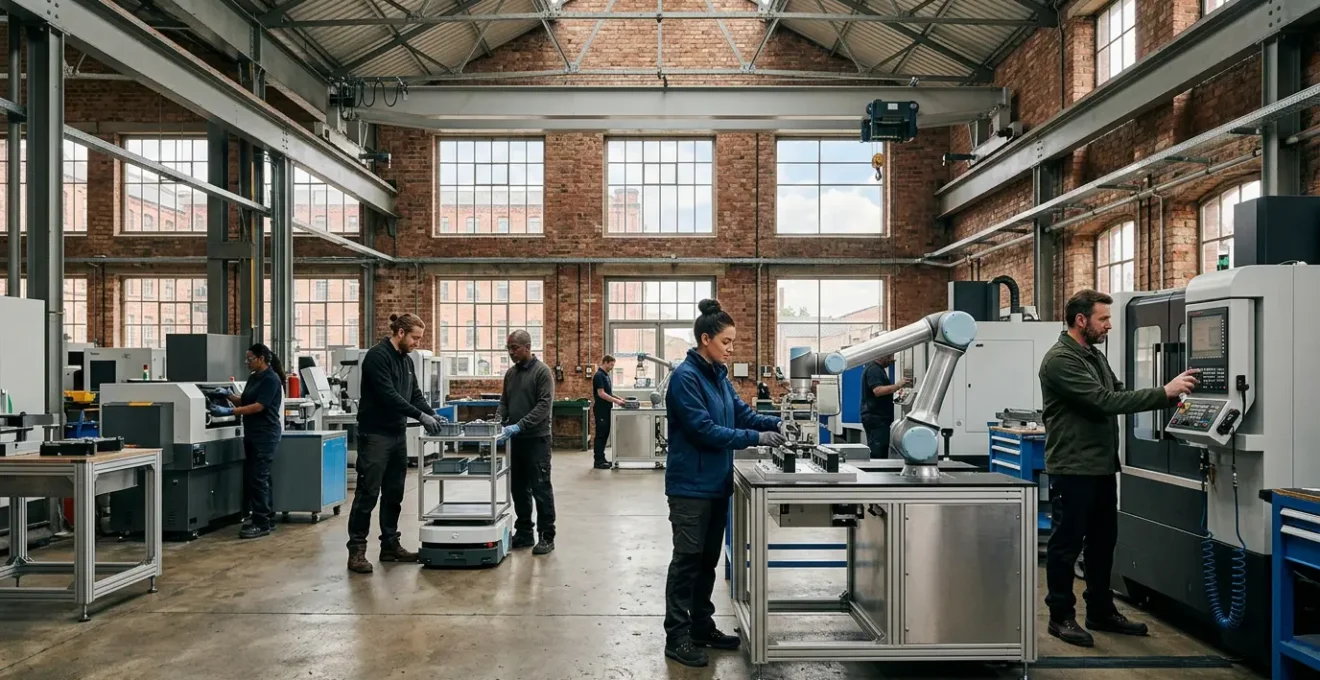
Disruptive technology isn’t replacing Northern industry; it’s forging a stronger, more valuable version by amplifying our core strengths.
- Job roles are evolving towards higher-skilled, better-paid positions, directly countering fears of mass unemployment in manufacturing.
- A pragmatic, Northern-centric approach to AI adoption focuses on measurable ROI and solving real-world problems, not chasing tech hype.
Recommendation: Business and policy leaders should focus on integrating smart technology to enhance existing industrial capabilities, rather than attempting to imitate other tech ecosystems.
The roar of the factory floor, the hum of the production line—these are the sounds that have defined the Northern economy for generations. Today, a new, quieter sound is joining them: the whir of servers and the silent logic of algorithms. For many business owners and policymakers across Manchester, Leeds, and the wider North, the term “disruptive technology” brings a mix of promise and anxiety. The common narrative often pits our industrial heritage against a digital future, framing automation and AI as existential threats to jobs and identity.
The conversation is saturated with platitudes about a looming “skills gap” or the necessity to “pivot to tech,” often presented with a sense of inevitability that can feel alienating. But what if this binary view is fundamentally wrong? What if the real opportunity for the Northern Powerhouse lies not in abandoning its industrial soul, but in augmenting it with intelligent, practical technology? This isn’t a guide to becoming a pale imitation of Silicon Valley or a satellite of London’s FinTech scene. This is a playbook for the Northern Powerhouse to win on its own terms.
This article moves beyond the fear and the hype. We will dissect the reality of our evolving manufacturing sector, offer a pragmatic roadmap for AI integration, and analyse the vibrant, competitive tech hubs growing right here. We’ll confront the cultural hurdles that hold businesses back and explore the uniquely Northern solutions emerging in our rural communities. The goal is to build a clear-eyed strategy for economic resilience, one that is proudly, and effectively, Northern.
Contents: How Disruptive Technology Is Forging a New Northern Economy
- Why Manufacturing Jobs in the North Are Evolving, Not Disappearing?
- How to Integate AI into Traditional Manufacturing Without Breaking the Bank?
- Manchester vs Leeds: Which City Is Leading the Tech Revolution?
- The Cultural Mistake That Kills Digital Adoption in Old Family Firms
- When to Invest in disruptive Tech: Being First vs Being Smart?
- How to Set Up Community Broadband When Openreach Won’t Connect You?
- Why 5G Digital Infrastructure Is Failing Rural UK Communities?
- Reading vs Cambridge: Which Tech Cluster Offers Better Entry Salaries?
Why Manufacturing Jobs in the North Are Evolving, Not Disappearing?
The narrative of robots wiping out factory jobs is a compelling but dangerously simplistic cliché. The reality on the ground, across the industrial heartlands of the North, tells a far more nuanced and optimistic story. Manufacturing jobs aren’t vanishing; they are transforming into higher-skilled, better-paid, and more strategic roles. The data paints a clear picture of an industry in evolution, not decline. In fact, the North West remains the UK’s manufacturing powerhouse, with an output of £29.5 billion and average salaries rising to a competitive £38,769. This salary growth isn’t happening in spite of technology; it’s happening because of it.
As repetitive manual tasks are automated, the demand for human expertise shifts to operating, maintaining, and optimising these new systems. This creates roles for process engineers, data analysts, and robotics technicians—jobs that leverage the North’s deep-seated manufacturing knowledge and fuse it with digital literacy. This trend isn’t isolated. The North East, for instance, produced the best results for output volumes and total orders in the UK during 2024, building on a strong prior year. This demonstrates a region successfully integrating new processes to boost productivity and competitiveness, which in turn secures its economic future.
The core takeaway for policymakers and business owners is this: the challenge isn’t stopping a tide of job losses, but navigating a wave of job transformation. Investment should be channelled not into preserving outdated roles, but into upskilling the current workforce to meet the demands of a smarter, more efficient factory floor. The true value of the Northern workforce lies in its ingrained industrial expertise, and technology is proving to be the tool that unlocks its next stage of growth.
How to Integate AI into Traditional Manufacturing Without Breaking the Bank?
The ambition to modernise is there, but for many Northern SMEs, the leap to Artificial Intelligence feels like a chasm. It’s a reality we all recognise: a recent ONS survey revealed that while many are aware of AI, only 9% of UK firms adopted AI in 2023, with barriers like cost, lack of expertise, and difficulty identifying a solid business case being the primary deterrents. The fear of a costly, failed project is real. However, a pragmatic, no-nonsense approach is emerging, perfectly suited to the Northern business mindset, which prioritises tangible results over speculative tech.
The key is to reframe the question from “How do we implement AI?” to “What is the most pressing problem on our factory floor that technology could solve?” This task-first approach demystifies the process and grounds it in clear, measurable objectives. It’s about starting small, proving value, and then scaling strategically. As Professor Chris Dungey, an AI champion for advanced manufacturing, puts it, the goal is to help businesses “move with confidence, avoid common pitfalls, and ensure AI delivers measurable impact rather than stalled pilots.”
This toolkit is not about pushing manufacturers faster than they are ready to go. It is about helping them move with confidence, avoid common pitfalls, and ensure AI delivers measurable impact rather than stalled pilots.
– Professor Chris Dungey, AI champion for advanced manufacturing at the Department for Business and Trade, Made Smarter AI Toolkit 2025
This means focusing on better data collection with simple sensors before investing in complex algorithms, or piloting a visual inspection tool for quality control on a single production line to prove its ROI. This incremental method de-risks the investment and builds internal expertise and confidence. It’s the manufacturing equivalent of learning to walk before you run—a sensible strategy that ensures every pound spent on technology is a pound well invested.
Action Plan: A Practical Framework for SME AI Adoption
- Scan: Start by identifying operational challenges and areas where AI can eliminate low-value, repetitive tasks. Focus on the problem first, not the technology.
- Pilot: Test a potential AI solution on a specific, measurable manufacturing problem, such as using predictive maintenance algorithms on a single critical machine.
- Scale: Expand the use of a proven AI solution only after it has demonstrated a clear, measurable Return on Investment (ROI).
- Data First: Prioritise better data collection on the factory floor using simple, affordable sensors before committing to expensive, data-hungry AI systems.
- Task-Oriented Focus: Ensure every pilot project is designed to solve a tangible business issue, guaranteeing that technology delivers impact rather than just being a stalled experiment.
Manchester vs Leeds: Which City Is Leading the Tech Revolution?
The old Pennine rivalry, once played out on football pitches and in industrial output, has found a new arena: the tech sector. Asking whether Manchester or Leeds is the “leader” of the North’s tech revolution is a favourite topic, but it misses the point. The reality is that their distinct, complementary strengths are what make the Northern Powerhouse ecosystem so resilient and compelling as a whole. It’s not a zero-sum game; it’s a showcase of a diverse and dynamic regional economy.
Leeds, for example, has seen its tech firms grow at an astonishing rate. New data reveals Leeds tech firms are growing 125% faster than the national average, a testament to its burgeoning scale-up scene. The city has carved out a powerful niche in B2B services, FinTech, and data analytics, building on its historic strengths in financial and professional services.
Manchester, meanwhile, presents a different but equally formidable profile. With a digital ecosystem valued at £5 billion and over 10,000 tech businesses, it boasts incredible scale. Its strengths lie more in B2C, media, cybersecurity, and HealthTech, creating a vibrant, consumer-facing tech landscape. The following comparison highlights not a winner and a loser, but two pillars of a powerful regional economy.
| Metric | Manchester | Leeds |
|---|---|---|
| Digital Ecosystem Value | £5 billion | £64.6bn total economy (21% growth forecast over 10 years) |
| Number of Tech Businesses | 10,000+ digital and tech businesses | Fast-growing tech sector with specialist strengths |
| Primary Sector Strengths | B2C, Media, HealthTech, Cybersecurity | B2B, FinTech, Data Analytics |
| VC Investment (Recent) | Part of £1.3bn Northern Triangle funding (5 years) | £288m (year to Sept 2022, up 88%) |
| Economic Growth Forecast | 2.5% annually (2024-2026), fastest in North | Strong scaleup growth, 125% above national average |
| Head of Transformation Salary | £92,500 | £98,750 (7% higher than London) |
Ultimately, the Manchester-Leeds dynamic demonstrates a mature ecosystem. Investors and businesses aren’t forced to choose one; they can leverage Manchester’s scale and B2C energy, or Leeds’s rapid B2B growth and deep specialisms. This internal competition and collaboration is precisely what is driving the entire region forward.
The Cultural Mistake That Kills Digital Adoption in Old Family Firms
Beyond the cost of new machinery or the challenge of finding skilled staff, there lies a more subtle and powerful barrier to digital transformation in the North’s many long-standing family firms: culture. It’s a tension played out not in boardrooms, but in conversations across the factory floor and the family dinner table. It’s the understandable resistance of a generation that built a successful business on tangible assets, trust-based relationships, and hard-won experience, now being asked to trust abstract data, cloud-based systems, and the advice of digital natives.
This isn’t simple Luddism. It stems from a deep-seated fear that digital transformation equates to a loss of control and transparency that feels threatening. For a founder who knows their business by the sound of a machine or the feel of a product, the idea of operations being managed by a dashboard can seem like an abdication of responsibility. The “secret sauce” of the business—the intuitive knowledge and informal processes—feels vulnerable when exposed to the cold, hard logic of data analytics. This creates a cultural stalemate where investment in technology is made reluctantly, but the deeper changes to process and mindset required to make it effective are never embraced.
The image below powerfully captures this generational and philosophical divide: the weathered hands that built the company, holding the tools of a physical trade, juxtaposed with the new era of digital interfaces. Breaking this deadlock requires empathy, not just a business case.

The solution isn’t to bulldoze the old culture but to build a bridge. It involves starting with technology that enhances, rather than replaces, the founder’s expertise. For instance, a simple sensor system that provides real-time data to validate a long-held intuition can be a powerful first step. It reframes technology as an amplifier of experience, not a replacement for it. Overcoming this cultural inertia is often the single most important—and most overlooked—step in securing a family firm’s future for the next generation.
When to Invest in Disruptive Tech: Being First vs Being Smart?
In the breathless narrative of tech disruption, there’s an implicit assumption that being first is everything. The “first-mover advantage” is held up as the ultimate prize. But for the vast majority of Northern businesses, particularly in capital-intensive sectors like manufacturing, this is a dangerous myth. Chasing the bleeding edge is expensive, risky, and often unnecessary. The smarter, more pragmatic Northern approach is to be a “fast follower” or, even better, a “smart implementer.”
The data shows that a cautious approach is the norm, not the exception. Despite high awareness, a 2025 government review found that only 8% of UK manufacturers had successfully introduced AI and machine learning, with a staggering 74% of SMEs operating without any robots. This isn’t a sign of failure; it’s a sign of pragmatism. As Made Smarter notes, “many SMEs have remained cautious about implementing AI, given the complexity of manufacturing settings.” They are waiting for the technology to mature, for the use cases to become clear, and for the return on investment to be undeniable.
Letting others absorb the high costs and painful lessons of early adoption is a perfectly valid strategy. The smart implementer waits for the second or third generation of a technology, when it’s more reliable, more affordable, and comes with a proven playbook. They don’t invest in a 3D printer; they invest in a proven manufacturing process that happens to use a 3D printer. They don’t buy “AI”; they buy a predictive maintenance solution that has a demonstrated track record of reducing downtime by a specific percentage. This focus on the business outcome, not the technology itself, is the hallmark of a wise investment strategy. In the North’s economic resurgence, being smart will always trump being first.
How to Set Up Community Broadband When Openreach Won’t Connect You?
For too many businesses and communities in the rural North, the promise of the digital economy hits a literal dead end: the fibre optic cable simply isn’t there. When commercial providers deem an area unprofitable, the response from the community can’t be to simply wait. The Northern way is to take matters into your own hands, and there is no better example of this grit and ingenuity than Broadband for the Rural North (B4RN).
Case Study: The B4RN Community-Owned Model
Launched in 2011, Broadband for the Rural North (B4RN) is a testament to what’s possible when a community refuses to be left behind. Operating as a Community Benefit Society—a legal structure that prevents it from being sold to a commercial operator and reinvests all profits back into the community—B4RN has delivered gigabit-speed fibre broadband across vast swathes of Lancashire, Cumbria, Yorkshire, and Northumberland. They’ve connected over 15,000 customers in areas long abandoned by major telcos. The model is a masterclass in patchwork funding: it combines government Gigabit Vouchers, community share offers where locals can invest or earn shares by volunteering (literally digging trenches), and securing free wayleaves from landowners. The result? A 1Gbps symmetrical service for a flat £33/month, proving that a world-class digital infrastructure can be built and run by the community, for the community.
The B4RN model provides a powerful blueprint. It’s not just about technology; it’s about social enterprise and community empowerment. As COO Tom Rigg stated, “B4RN was started to help local communities thrive and survive. Without up-to-date broadband infrastructure, communities go under and disappear.” This model proves that connectivity is not just a commercial service but a vital piece of social infrastructure, like water or electricity.
For any rural area facing the same challenge, the path involves a combination of legal savvy (choosing a CIC or Community Benefit Society structure), financial creativity (combining grants, vouchers, and community shares), and, most importantly, mobilising the local community. It is a monumental effort, but B4RN shows it is not only possible but can create a lasting economic and social asset that is owned and controlled by the people it serves.
Why 5G Digital Infrastructure Is Failing Rural UK Communities?
While city centres are blanketed with talk of 5G and the Internet of Things, many rural businesses across the North can only dream of a stable 4G signal, let alone the next generation of connectivity. The failure of digital infrastructure to penetrate our rural communities is not a technical problem; it is a market failure, pure and simple. The commercial logic of the UK’s primary network providers is dictated by population density and return on investment, a calculus that invariably leaves sparsely populated areas at the back of the queue.
The fundamental issue was laid bare in documentation surrounding community broadband projects. The core principle is that a certain density of paying customers is required to justify the high capital expenditure of laying fibre or erecting masts. This cold economic reality is a chasm that government rhetoric often fails to cross.
The UK government defines super-fast broadband as 25Mbs and this speed of service would never be delivered to a rural area by any of the primary network service providers because such a service would not give a return on investment.
– B4RN Case Study Documentation, Smartoptics B4RN Community Fiber Network Case Study
This creates a two-tier digital nation. A manufacturer in a rural part of Yorkshire or Cumbria is prevented from adopting cloud-based inventory systems, a farmer can’t use IoT sensors for crop management, and a creative agency can’t reliably upload large files for clients. This isn’t a minor inconvenience; it is a fundamental barrier to economic participation. It strangles innovation, hampers productivity, and accelerates the very ‘brain drain’ that regional policy aims to prevent. Until the provision of digital infrastructure is treated less like a commercial commodity and more like an essential utility, rural communities across the North will continue to be held back, unable to fully leverage the disruptive technologies that are reshaping the wider economy.
Key Takeaways
- Evolution, Not Extinction: Northern manufacturing jobs are becoming more skilled and better paid through technology, not disappearing.
- Pragmatic AI Adoption: The “Scan, Pilot, Scale” model offers a low-risk, high-ROI path for SMEs to integrate AI effectively.
- Community-Powered Infrastructure: When national providers fail, Northern communities are proving they can build their own world-class digital networks like B4RN.
- Value Over Hype: The North’s competitive advantage lies in offering superior economic value and quality of life, not just chasing London’s salary benchmarks.
Reading vs Cambridge: Which Tech Cluster Offers Better Entry Salaries?
The London-centric view of the UK economy often frames the discussion around a few dominant Southern tech hubs. Questions about salaries in Reading or Cambridge are valid, but for a business owner or potential employee in the North, they are increasingly the wrong questions. The more pertinent and powerful question is: what is the true value proposition of a tech career in the Northern Powerhouse? The answer is shifting the balance of power, proving the North competes not just on cost of living, but on pure earning potential and quality of life.
While the South may still hold a perception of higher pay, the data on senior, strategic roles tells a startlingly different story. A recent survey revealed that for a critical ‘Head of Transformation’ role, the average salary in Manchester and Leeds is now £98,750. According to SPG Resourcing’s 2025 UK tech salary survey, that figure is over 7% higher than the London average of £92,500. For ‘Head of Data’ roles, salaries in the North now match London’s at £120,000. This isn’t about being a “cheaper alternative”; this is about offering superior earning power in key strategic positions.

When you combine this direct salary competitiveness with the significantly lower cost of living—particularly in housing—the concept of ‘effective salary’ becomes dramatically skewed in the North’s favour. The conversation is no longer about trading salary for lifestyle; it’s about achieving both. This potent combination of high-value roles, competitive pay, and a higher quality of life is the North’s true disruptive offering in the war for talent. It demonstrates an ecosystem that has matured beyond simply providing support services for the South and is now generating its own high-value economic gravity.
For any business or policymaker in the North, the path forward is clear. It’s time to move beyond the defensive crouch of reacting to disruption and adopt an assertive posture of using it to our advantage. By focusing on pragmatic adoption, investing in our people, and building on our unique industrial and community strengths, the Northern Powerhouse can and will forge a resilient, innovative, and authentically Northern economic future.