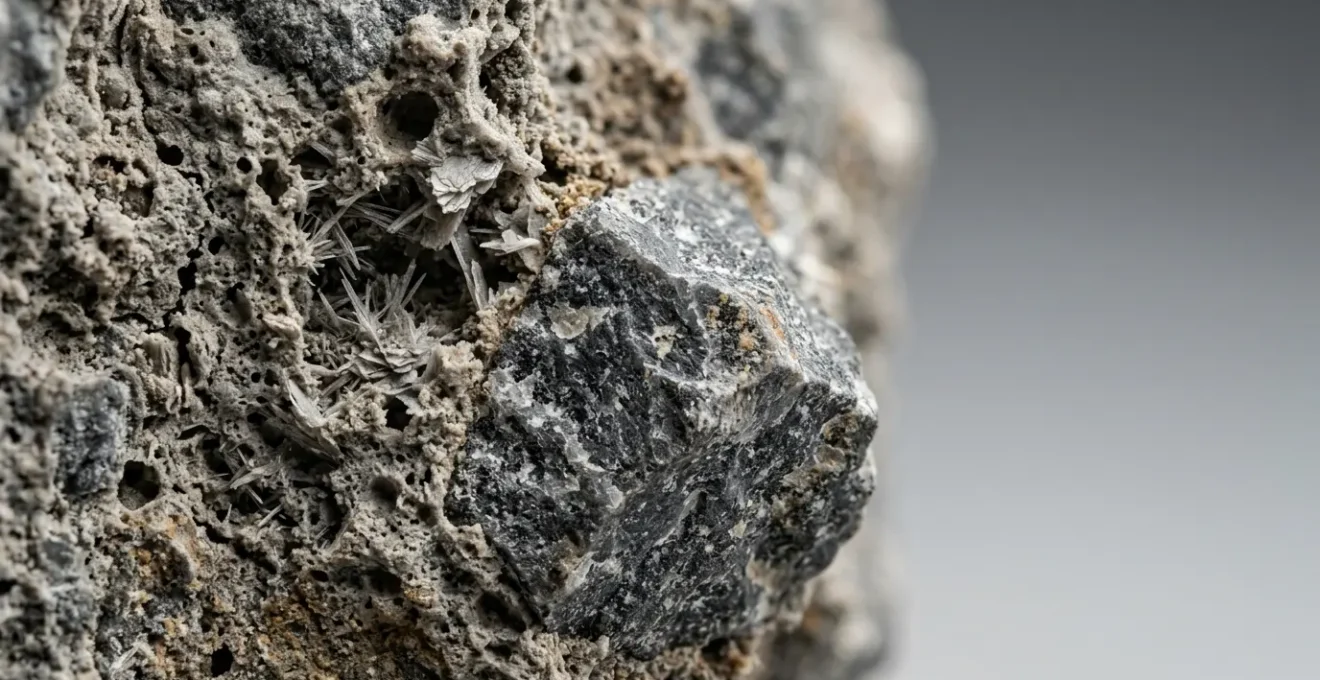
The structural integrity of UK buildings and infrastructure is not determined by blueprints alone, but by the invisible world of microscopic material properties.
- Minor oversights in material specification and handling can introduce catastrophic weaknesses, such as cracks and chemical instabilities, that are invisible to the naked eye.
- Forensic analysis techniques provide the necessary data to predict long-term material behaviour, prevent failures, and ensure compliance with safety-critical standards.
Recommendation: Integrate microscopic material verification as a non-negotiable quality gate in all stages of a project, from material sourcing to post-construction monitoring.
For civil engineers and architects in the United Kingdom, ensuring the longevity of a structure is a primary directive. We rely on building codes, material specifications, and established engineering principles. Yet, catastrophic failures still occur. Structures that appear sound can hide deep, systemic weaknesses. The uncomfortable truth is that the greatest threats to our concrete and steel are not always visible. They are born in the microscopic spaces between grains of cement and crystals of metal, growing silently until it is too late.
The common approach focuses on macroscopic testing—load-bearing capacity, tensile strength, and visual inspections. While essential, this is only half the story. The real battle for durability is fought at the micron level. This is where issues like Alkali-Silica Reaction (ASR), interstitial corrosion, and freeze-thaw degradation begin. To overlook this domain is to gamble with public safety and asset lifespan. The key to building resilient infrastructure lies not in simply using stronger materials, but in understanding their vulnerabilities at a microscopic level. This perspective shifts the focus from reactive repair to proactive, forensic prevention.
This article will not re-state the basics of material science. Instead, it serves as a forensic brief, exploring critical microscopic failure points specific to the UK environment. We will examine why legacy concrete poses a hidden risk, how to test for invisible flaws, how material origins impact durability, and how environmental factors from coastal salt to warehouse dampness can trigger internal decay. By adopting a microscopic viewpoint, we can move from building structures to engineering legacies.
In the following sections, we explore the critical failure points and analytical methods that every UK-based engineer and architect must understand to ensure the long-term safety and stability of their projects. This guide provides a detailed look into the microscopic world where structural integrity is truly won or lost.
Summary: A Forensic Analysis of UK Construction Material Integrity
- Why Micro-Cracks in 1960s Concrete Are a Ticking Time Bomb?
- How to Perform Non-Destructive Testing on Critical Support Beams?
- British Steel vs Imported Alloys: Which Holds Up Better Microscopically?
- The Salt Air Mistake That Corrodes Coastal Structures from the Inside
- How to Adjust Concrete Micro-Structure for UK Freeze-Thaw Cycles?
- The Storage Error That Compromises Chemical Stability in Damp Warehouses
- The Zoning Mistake That Puts New Developments Underwater
- How Chemical Analysis Prevents Industrial Accidents in UK Factories?
Why Micro-Cracks in 1960s Concrete Are a Ticking Time Bomb?
Concrete structures from the mid-20th century form a significant portion of the UK’s infrastructure. While seemingly robust, they harbour a hidden vulnerability: their microscopic composition. Concrete from this era was often mixed with less stringent controls over aggregate reactivity and water-cement ratios, leading to a porous microstructure. Crucially, research from the University of Oxford reveals that even modern concrete contains an initial volume fraction of voids and microcracks of around 1.1%, a figure likely higher in older formulations.
These initial voids are not inert. They form a network of pathways allowing the ingress of water, chlorides, and carbon dioxide. This initiates a cascade of deleterious chemical reactions, the most notorious of which is the Alkali-Silica Reaction (ASR). ASR is a gel-forming reaction between the alkaline cement paste and reactive silica aggregates. This gel expands upon contact with moisture, exerting immense internal pressure that creates an ever-widening network of micro-cracks, ultimately compromising the concrete’s structural integrity from within.
The danger is that this damage is cumulative and often shows no external signs until it reaches a critical stage. What appears as minor surface crazing could be the symptom of advanced internal degradation. This makes forensic analysis of core samples not just a diagnostic tool, but a necessary predictive measure for assessing the remaining service life of these ageing assets.
Case Study: The Proactive Prevention of ASR in the UK
The threat of ASR is not merely theoretical. Following several incidents in the 1970s and 80s, the UK construction industry took decisive action. According to The Concrete Society, the introduction of stringent specifications to limit alkali content in cement and avoid reactive aggregates has been remarkably successful. As a result, no confirmed incidences of ASR have been recorded in UK structures built since 1987. This demonstrates a critical lesson: understanding a material’s microscopic failure mechanism is the key to engineering it out of existence, turning a “ticking time bomb” into a solved problem for future generations.
How to Perform Non-Destructive Testing on Critical Support Beams?
Assessing the internal health of a critical support beam without compromising its function is a core challenge in structural engineering. Non-Destructive Testing (NDT) provides a suite of methods to achieve this, offering a window into the material’s microstructure. One of the most effective techniques for concrete is Ultrasonic Pulse Velocity (UPV) testing. This method involves sending a high-frequency sound wave through the beam and measuring the time it takes to travel from the transmitter to the receiver.
The velocity of the pulse is directly related to the density and elasticity of the concrete. A high, consistent velocity indicates dense, high-quality concrete with good compaction. Conversely, lower velocities or significant variations can signify the presence of internal voids, honeycombing, or, most critically, micro-cracks. These discontinuities force the ultrasonic wave to travel around them, increasing its path length and transit time. By mapping velocities across a beam, an engineer can create a tomographic image of its internal condition, pinpointing areas of potential weakness long before they become visible.
This paragraph introduces the concept of using ultrasonic waves to see inside concrete. The illustration below visualizes how these waves propagate, revealing the hidden internal structure and potential defects.
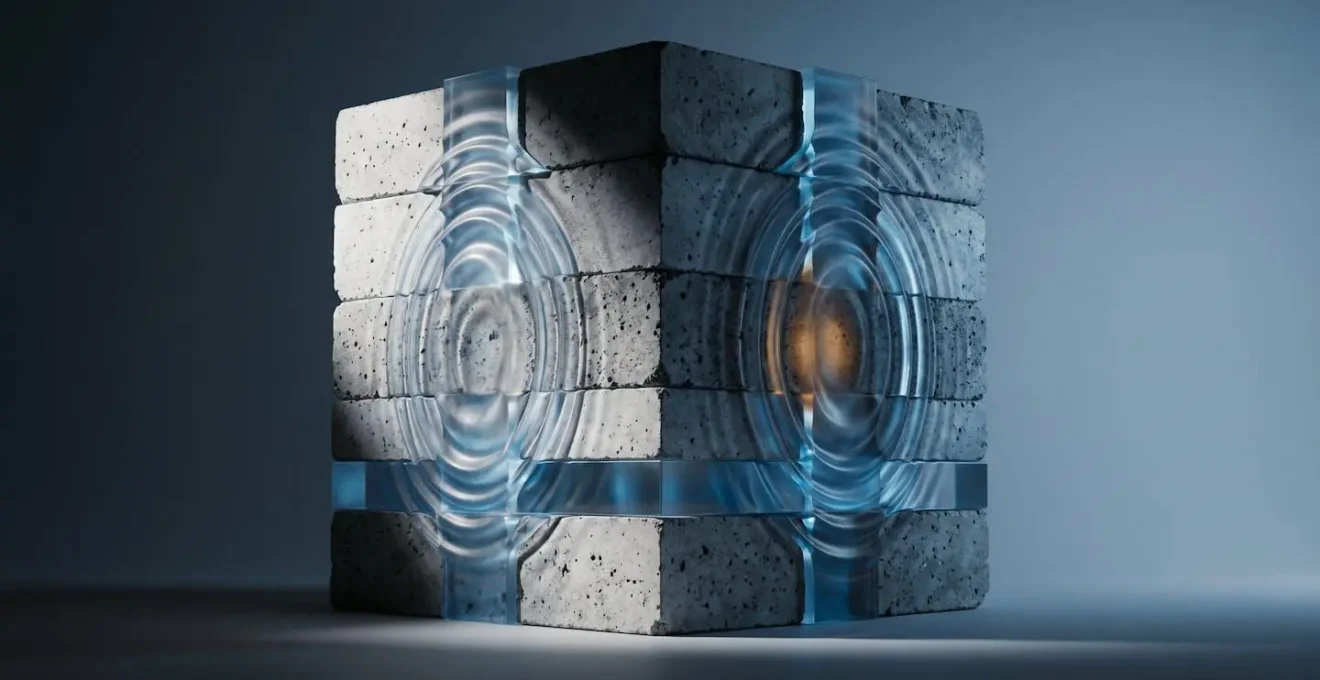
As the diagram illustrates, the analysis of these wave patterns is crucial. It allows for the identification of anomalies without the need for destructive core sampling, preserving the integrity of the structure while providing actionable data for maintenance or reinforcement planning. This makes UPV an indispensable tool in the forensic engineer’s arsenal for evaluating the health of existing structures.
Field Audit Checklist: Verifying Beam Integrity with NDT
- Points of contact: Identify and map all load-bearing points, historical stress concentrators, and areas exposed to environmental aggressors (e.g., de-icing salts, water runoff).
- Collecte: Inventory all existing documentation, including original blueprints, past inspection reports, and material specifications for the beam.
- Coherence: Calibrate NDT equipment (e.g., UPV tester) on a known sound section of the concrete to establish a baseline velocity for the structure.
- Mémorabilité/émotion: Conduct a grid-based scan of the entire beam, noting any significant velocity drops or anomalies that deviate from the baseline. Mark these areas for further investigation.
- Plan d’intégration: Correlate NDT findings with visual inspection data and historical records. Prioritise anomalous areas for more detailed analysis or targeted repair strategies.
British Steel vs Imported Alloys: Which Holds Up Better Microscopically?
The debate over domestic versus imported steel often centres on cost and availability, but for a forensic engineer, the critical differentiator lies in the microstructure. Steel is not a monolithic material; it is a crystalline structure of iron and carbon, with its properties defined by the size, shape, and distribution of these crystals (or “grains”) and the presence of other alloying elements. The quality of steel is a direct function of the control exercised during its production—from the purity of the raw materials to the precision of the heating and cooling cycles.
British steel has historically been produced under some of the world’s most stringent quality assurance standards. This translates to a more uniform, fine-grained microstructure with a consistent and predictable distribution of elements. A fine-grained structure is generally tougher and more resilient, as the numerous grain boundaries act as barriers to the propagation of micro-cracks.
In contrast, some imported alloys, particularly those sourced from regions with less rigorous regulatory oversight, can exhibit microscopic inconsistencies. These may include larger, more irregular grain sizes, or the presence of unwanted inclusions (impurities) such as sulphides or oxides. These inclusions act as stress concentrators, creating initiation points for fatigue cracks under cyclic loading. Furthermore, inconsistencies in alloy composition can lead to variations in corrosion resistance across a single component, creating micro-anodes and micro-cathodes that accelerate localised corrosion, a phenomenon not dissimilar to galvanic corrosion.
The microstructure of a substance is the way molecules are bonded together with forces acting between them. The microstructure cannot be seen with the human eye but can be studied under a microscope.
– Metal Supermarkets UK, What Are The Different Types of Steel & Steel Grades?
Therefore, while two steel beams may have identical macroscopic specifications, microscopic analysis via metallography can reveal a profound difference in their long-term durability and reliability. For safety-critical applications, verifying the material’s microscopic pedigree is not a luxury, but a necessity.
The Salt Air Mistake That Corrodes Coastal Structures from the Inside
The United Kingdom is an island nation, and a vast amount of its infrastructure is exposed to a marine environment. The most common mistake in designing for these locations is underestimating the insidious nature of airborne chlorides. Salt-laden mist is more than just a surface nuisance; it is a catalyst for internal destruction, particularly in reinforced concrete. The primary defence of steel rebar against corrosion is the high alkalinity of the surrounding concrete, which forms a passive, protective oxide layer.
Airborne chloride ions, carried by sea spray, penetrate the porous microstructure of the concrete over time. Once they reach the rebar in sufficient concentration, they break down this passive layer, initiating an aggressive form of localised pitting corrosion. This process is self-catalysing and can proceed rapidly even with low oxygen levels. The rust products (iron oxides) occupy a much larger volume than the original steel, creating immense tensile stress within the concrete. This leads to cracking, spalling (delamination of the concrete cover), and a further acceleration of corrosion as more of the rebar is exposed.
The critical factor is not just the presence of salt, but also humidity. The initiation of chloride-induced corrosion and other deleterious reactions like ASR is heavily dependent on moisture. According to research by Kagimoto and Kawamura, the process accelerates dramatically when relative humidity exceeds a threshold of 80-90%, a common condition in UK coastal areas. Designing for coastal durability therefore requires a microscopic focus on creating a dense, impermeable concrete matrix—using low water/cement ratios, supplementary cementitious materials like fly ash, and ensuring adequate concrete cover over the rebar—to keep chlorides and moisture out.
Modern projects like the Thames Tideway Tunnel exemplify this approach, where concrete mix designs are specifically engineered at a microscopic level to provide a service life of over 100 years in a challenging chloride-rich environment. This proves that longevity is achieved not by fighting the environment, but by understanding and designing against its microscopic mechanisms.
How to Adjust Concrete Micro-Structure for UK Freeze-Thaw Cycles?
The UK’s temperate but variable climate presents a specific challenge for concrete durability: freeze-thaw cycles. Water is the enemy of concrete, and when it penetrates the material’s porous structure and freezes, it expands by approximately 9%. This expansion exerts enormous hydraulic pressure on the walls of the microscopic pores and capillaries within the cement paste. Repeated cycles of freezing and thawing act like a relentless microscopic jackhammer, leading to progressive micro-cracking, surface scaling, and eventual structural degradation.
The common assumption is that a strong, dense concrete is sufficient protection. This is a dangerous oversimplification. While low permeability is important to reduce water ingress, it is impossible to create a completely waterproof material. The solution is not to just block water, but to manage its presence within the microstructure. The most effective defence is a technique known as air-entrainment. This involves intentionally introducing billions of microscopic, stable air bubbles into the fresh concrete mix.
This illustration shows a magnified cross-section of air-entrained concrete, revealing the network of tiny bubbles that provide critical protection against freezing.
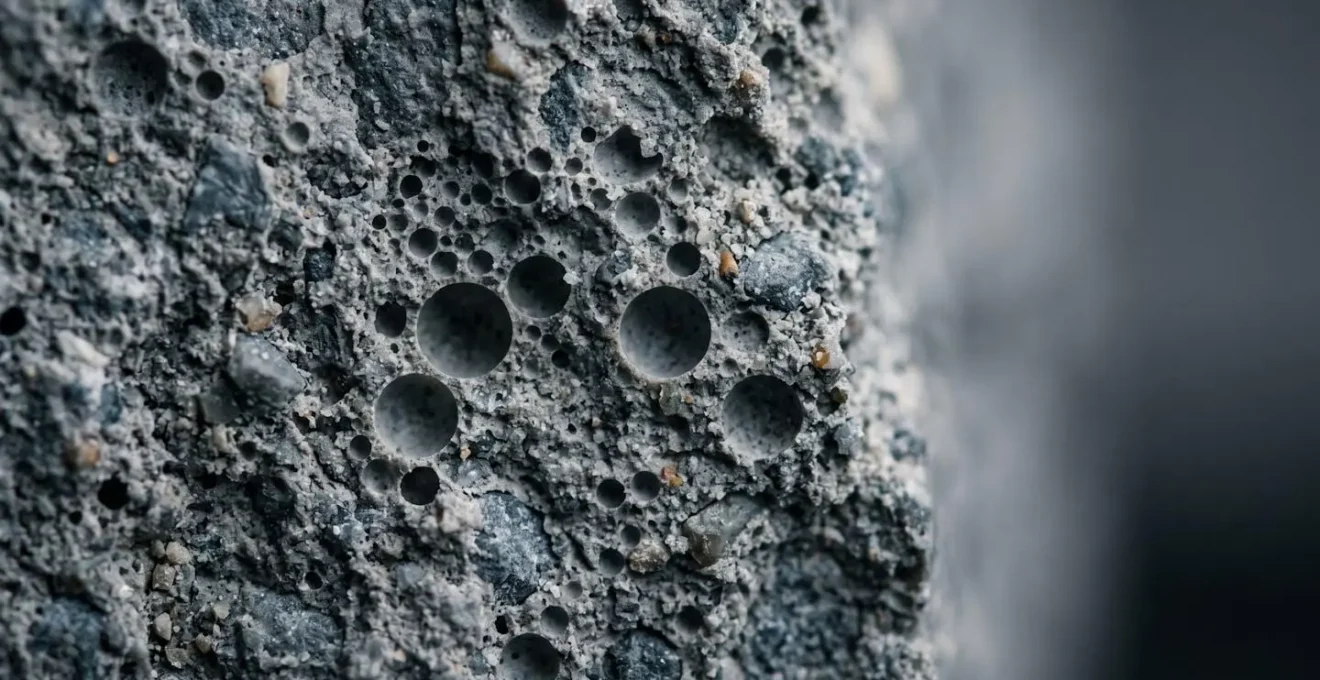
These air voids act as tiny pressure-relief valves. When water in the capillaries begins to freeze and expand, it is forced into these empty air bubbles before it can build up enough pressure to fracture the surrounding cement matrix. For this system to be effective, the air voids must be extremely small, well-distributed, and closely spaced. A forensic petrographic analysis of hardened concrete can verify the characteristics of the air-void system, confirming whether the material is adequately protected against the UK’s damaging freeze-thaw cycles.
The Storage Error That Compromises Chemical Stability in Damp Warehouses
The chemical stability of construction materials is often assumed, but it is highly dependent on their storage conditions prior to use. This is particularly true for cementitious products and certain chemical admixtures. A common and critical error is storing these materials in damp, poorly ventilated warehouses, a frequent condition during the UK’s wetter months. This seemingly minor logistical oversight can have profound consequences on the material’s microscopic and chemical properties.
For bagged cement, high ambient humidity can initiate a process known as pre-hydration. Moisture from the air reacts with the outer layers of the cement particles, forming a partially hydrated crust. While the material may still appear to be a fine powder, a significant portion of its reactive potential has been lost. When this cement is later used in a concrete mix, it will have lower strength development, increased setting times, and reduced ultimate durability. Microscopically, the hydration process will be incomplete, leading to a more porous and weaker cement paste.
The danger extends beyond cement. Many performance-enhancing admixtures, such as superplasticisers or accelerators, are complex organic molecules that can be sensitive to moisture and temperature. Improper storage can lead to their degradation, rendering them ineffective. Using such compromised materials can lead to catastrophic failures in performance, such as a complete lack of workability in a concrete pour or, as noted by industry experts, a dramatic loss in surface integrity. As Heidelberg Materials UK warns, improperly cured concrete can be as much as 50% less durable and highly prone to dusting and delamination.
Therefore, microscopic analysis is not just a tool for post-construction failure investigation; it is also a vital quality control method for raw materials. Verifying the chemical composition and physical state of materials upon delivery, especially after storage in potentially damp conditions, is a critical step in preventing latent defects from being built into a new structure.
The Zoning Mistake That Puts New Developments Underwater
Local authority zoning maps are a macroscopic tool for a microscopic problem. They delineate flood plains and development boundaries based on historical data and topographical surveys, but they fail to account for a critical variable: the microscopic behaviour of the soil itself. A zoning designation is a two-dimensional overlay on a complex, three-dimensional geotechnical reality. The mistake is assuming that all ground within a “safe” zone is uniformly stable, especially under the dual pressures of new construction loads and a changing climate.
The Thames Gateway development area is a prime UK case study. Much of the land is reclaimed marshland, composed of estuarine alluvium—a mix of clay, silt, and organic matter. From a macroscopic zoning perspective, parts of this land are designated for development. However, a microscopic analysis of the soil reveals a different story. The clay minerals in this alluvium have a high potential for shrink-swell behaviour with changes in moisture content. Furthermore, the organic matter can decompose over time, leading to settlement.
A simple zoning map cannot reveal this. Only a detailed geotechnical investigation, including microscopic mineralogical assessment and soil mechanics testing, can accurately predict how the ground will behave under the load of a new building and with rising groundwater levels. This analysis determines key parameters like soil permeability, shear strength, and consolidation characteristics. Ignoring this microscopic detail in favour of a broad zoning classification is to risk significant structural damage from differential settlement or, in the worst case, catastrophic failure due to soil liquefaction or subsidence. The ground beneath our feet is not a static platform; it is a dynamic material whose behaviour is governed by its microscopic composition.
Key Takeaways
- Structural failure often begins with invisible micro-cracks and chemical reactions, making microscopic analysis essential for prevention.
- Non-Destructive Testing (NDT) is a critical tool for assessing the internal health of existing structures without causing damage.
- Environmental factors specific to the UK, such as freeze-thaw cycles and coastal salt air, must be countered by designing the material’s microstructure accordingly.
How Chemical Analysis Prevents Industrial Accidents in UK Factories?
In the context of industrial facilities, the role of chemical and microscopic analysis extends beyond long-term durability to the immediate prevention of accidents. In UK factories, which operate under strict Health and Safety Executive (HSE) regulations, material integrity is directly linked to operational safety. Whether it’s a steel pressure vessel, a chemical storage tank, or a concrete machine foundation, an unforeseen material failure can have catastrophic consequences.
Forensic chemical analysis serves as a proactive safety measure. For metallic components, techniques like X-ray fluorescence (XRF) can verify that an alloy’s composition matches its specification, ensuring it possesses the required strength and corrosion resistance for its intended service. This is critical for preventing failures from phenomena like stress corrosion cracking, where a specific chemical environment causes brittle fracture in a normally ductile material. Microscopic analysis using a Scanning Electron Microscope (SEM) can reveal the early stages of fatigue cracking or intergranular corrosion long before they compromise the component.
For concrete structures in industrial settings, chemical analysis of core samples can detect the ingress of aggressive chemicals from spills or process environments, which can degrade the cement paste and corrode reinforcement. Furthermore, the correlation between physical properties and testable metrics is incredibly strong. Research into destructive and non-destructive testing methods shows a correlation coefficient of R² = 0.984 between ultrasonic pulse velocity and compressive strength. This near-perfect correlation means NDT is not just an indicator but a reliable predictor of a material’s condition.
By integrating a regime of regular microscopic and chemical analysis, facility managers can shift from a reactive maintenance model (fixing things when they break) to a predictive one (addressing weaknesses before they become failures). This not only prevents accidents and protects personnel but also minimizes unplanned downtime, making it a cornerstone of both safety and operational excellence in modern UK manufacturing.
For every project, the next step is to implement a rigorous quality assurance program that mandates microscopic verification at every critical stage, from material sourcing to ongoing structural health monitoring.