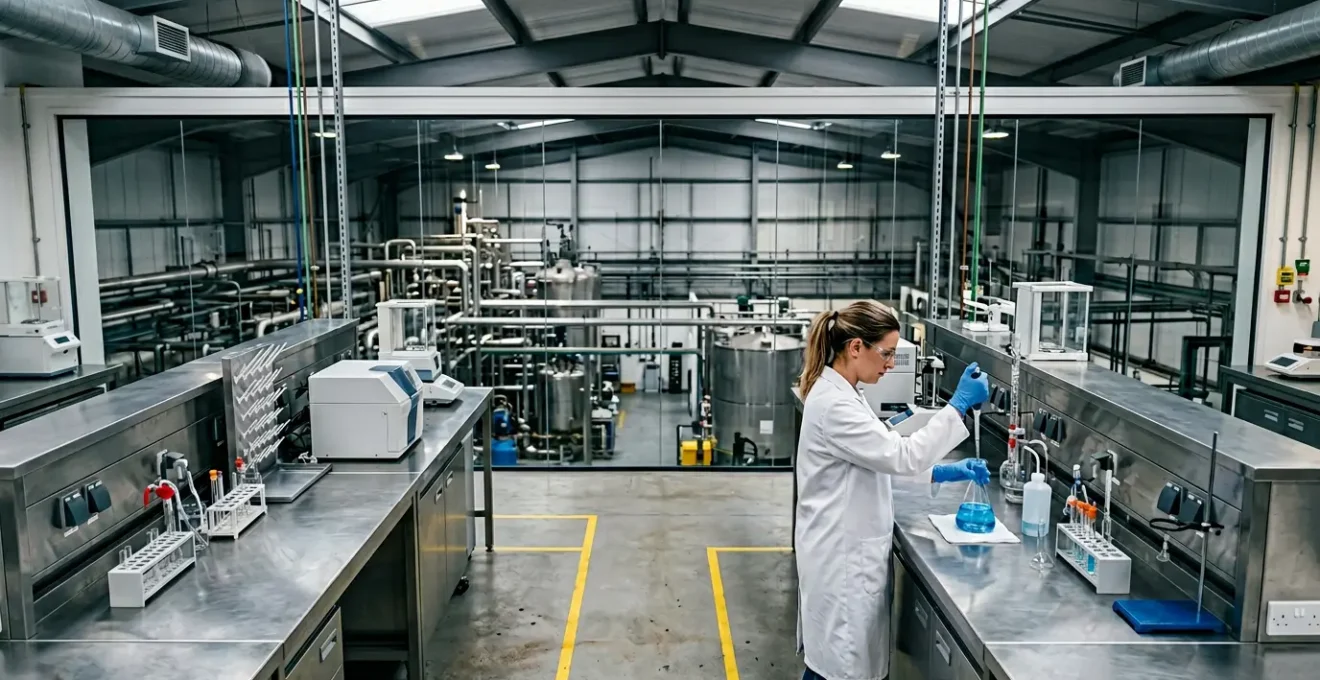
Compliance is not a checkbox; it is a continuous, evidence-based process of analytical vigilance that forms your only true defence against major industrial incidents.
- Minor, undetected chemical deviations are the primary precursors to catastrophic system failures, especially in aging infrastructure.
- Real-time process analytical technology (PAT) is no longer optional; it is essential for proactive control and maintaining a defensible safety record under HSE scrutiny.
Recommendation: Your duty is to shift from reactive testing to a state of ‘analytical vigilance’, embedding rigorous chemical analysis into every stage of your process to build a legally defensible safety case.
As a Health and Safety Executive (HSE) inspector, I witness the consequences of failed compliance daily. Process engineers and safety officers across the UK are under immense pressure to prevent industrial accidents, yet a fundamental misunderstanding persists. The prevailing approach often treats safety as a checklist to be completed—a series of boxes to tick regarding COSHH assessments or equipment maintenance. This is a dangerous and fundamentally flawed perspective. It addresses the symptoms of risk, not the root causes, which are almost invariably molecular.
This document is not another vague exhortation to “be safe.” It is a regulatory directive. It outlines why superficial safety protocols fail and demonstrates that the only true, defensible safety strategy is one built on a foundation of rigorous, proactive, and continuous chemical analysis. We will move beyond the platitudes and examine the precise analytical failures that lead to HSE non-compliance and catastrophic incidents. This is not about feeling safe; it’s about proving, with irrefutable data, that your operations are safe. This is analytical vigilance.
This guide will detail the specific analytical methodologies required to maintain a defensible safety record in a UK industrial setting. We will examine how minor chemical imbalances escalate into major breaches, how to implement real-time monitoring, and how to document your findings to withstand regulatory scrutiny. Consider this your new operational standard.
Summary: A Guide to Analytical Vigilance in UK Manufacturing
- Why Minor Chemical Imbalances Cause Major Safety Breaches?
- How to Set Up Real-Time Reaction Monitoring Without Halting Production?
- Spectroscopy vs Chromatography: Which Is Best for Rapid Quality Control?
- The Storage Error That Compromises Chemical Stability in Damp Warehouses
- How to Tweak Molecular Conditions to Boost Yield by 15%?
- The Salt Air Mistake That Corrodes Coastal Structures from the Inside
- How to Document Work Experience to Ace the End Point Assessment?
- How Analyzing Microscopic Structures Improves UK Construction Materials?
Why Minor Chemical Imbalances Cause Major Safety Breaches?
Major industrial accidents are not spontaneous events. They are the final, catastrophic result of a chain of seemingly minor, unaddressed failures. The most insidious of these are the microscopic chemical imbalances that silently degrade the integrity of your process systems. In the UK, the consequences are stark, with chemical exposure contributing to a significant number of workplace fatalities; HSE statistics attribute an estimated 13,000 deaths each year to past occupational exposures. This is not a matter of chance; it is a failure of analytical vigilance.
A classic UK case, the 1974 Flixborough disaster, serves as a permanent reminder. A leak of cyclohexane vapour from ruptured pipework led to an explosion that killed 28 people. The investigation revealed that minor, undetected changes in chemical composition interacting with aging infrastructure were the root cause. This illustrates a critical regulatory point: your responsibility extends to understanding the molecular state of your entire system, not just the final product. Trace metal impurities acting as unintended catalysts, microscopic corrosion, or slight pH drifts are not trivial details. They are non-conformance triggers that, left unmonitored, will inevitably compromise process safety.

The image above is not an abstract pattern; it is a visual representation of a ticking clock. These are the trace impurities and corrosion patterns inside industrial pipework that an inspector looks for. Each crystalline structure is a potential point of failure. Your mandate is to detect these changes at the parts-per-million level, long before they become visible to the naked eye or manifest as a leak. Failure to do so is not merely a technical oversight; it is a direct breach of your duty of care and a violation of fundamental safety principles.
How to Set Up Real-Time Reaction Monitoring Without Halting Production?
The traditional model of quality control—taking samples from a production line for offline laboratory analysis—is obsolete for process safety. By the time a deviation is detected, the compromised batch may already be complete, representing both a financial loss and a significant safety risk. The regulatory expectation, and the only logical approach, is the implementation of real-time monitoring through Process Analytical Technology (PAT). This is non-negotiable for any modern manufacturing facility.
PAT is not a single instrument but a system for designing, analysing, and controlling manufacturing through timely measurements of critical quality and performance attributes. The objective is to ensure final product quality through process understanding, not post-production testing. As demonstrated in recent biopharmaceutical applications, real-time insight allows for continuous performance monitoring and automated interventions, preventing deviations before they occur. This shift from a reactive to a proactive stance is a core tenet of modern industrial safety management.
Implementing PAT does not require a complete shutdown or a revolutionary overhaul of your plant. It must be a phased, methodical process. A compliant implementation model for a UK facility follows a strict, three-phase approach to ensure return on investment, data integrity, and regulatory adherence. The focus is on building a robust system of analytical vigilance that integrates seamlessly with existing infrastructure.
The deployment of PAT must be structured and documented. A logical three-phase implementation model for UK facilities should include:
- Pilot Phase: Begin on a non-critical production line. The objective is to validate the chosen PAT technology (such as Raman or Near-Infrared probes) against your current at-line analysis methods. This phase must include a clear calculation of the return on investment.
- Integration Phase: Once validated, integrate the PAT system with your existing SCADA/DCS infrastructure. This involves configuring automated alerts for critical process parameters and establishing data acquisition protocols that are fully compliant with UK data integrity requirements.
- Compliance Phase: The final step is to develop a UK-specific compliance package. All monitoring protocols must be explicitly aligned with MHRA Good Manufacturing Practice and HSE COSHH regulations. This ensures the system is not only functional but also audit-ready for regulatory scrutiny.
Spectroscopy vs Chromatography: Which Is Best for Rapid Quality Control?
The choice of analytical technique is not merely a technical decision; it is a strategic one that directly impacts your ability to conduct rapid, effective quality control. For process safety, speed is paramount. While both spectroscopy and chromatography are powerful tools, they serve fundamentally different roles in a high-throughput industrial environment. Your selection must be justified based on the specific demands of the application and the need for immediate, actionable data.
Chromatography, particularly High-Performance Liquid Chromatography (HPLC) and Gas Chromatography (GC), offers unparalleled separation and quantification capabilities. It is the gold standard for detailed impurity profiling and final product certification. However, its primary drawback is time. A typical chromatographic run can take anywhere from 15 minutes to over an hour, excluding sample preparation. This time lag makes it inherently unsuitable for real-time process control where decisions must be made in seconds.
Spectroscopic methods, such as Near-Infrared (NIR), Raman, and UV-Vis, offer the solution. These techniques measure the interaction of light with matter, providing an instantaneous chemical “fingerprint” of the sample. While generally less sensitive than chromatography for trace analysis, their speed is a game-changing advantage for at-line or in-line monitoring. A spectroscopic measurement can be completed in seconds, providing immediate feedback on critical parameters like concentration, moisture content, or reaction completion. This allows for genuine process understanding and control, aligning perfectly with the objectives of PAT.
The trade-off is clear and has been validated by experts in demanding fields. As one research team noted when developing methods for quality control:
Chromatographic methods are powerful, but their implementation is costly and sometimes tedious. According to our criteria, chromatographic methods are not suitable to high-throughput analytical quality control.
– Research team at University Hospital, Journal of Pharmaceutical and Biomedical Analysis
Therefore, the regulatory perspective is clear: for rapid process control and safety monitoring, spectroscopy is the required tool. Chromatography remains essential for final validation and detailed investigation, but it cannot be your first line of analytical defence.
The Storage Error That Compromises Chemical Stability in Damp Warehouses
The focus on process safety often overlooks a critical vulnerability: the chemical warehouse. Improper storage is not a trivial housekeeping issue; it is a primary cause of chemical degradation that can introduce unknown and hazardous variables into your production line. A damp, poorly ventilated warehouse is a chemical reactor in slow motion. In the UK, around 1,000 chemical incidents are reported each year, with a significant number originating not in the process hall but in the storage bay.
The primary antagonist in a damp warehouse is water. Atmospheric moisture can initiate hydrolysis in sensitive reagents, cause caking in hygroscopic powders which alters their reactivity, and accelerate the corrosion of storage containers, leading to contamination and leaks. A steel drum that looks intact from the outside may be compromised by internal corrosion due to moisture ingress, introducing metallic ions that can act as dangerous, unintended catalysts in your process. This is a direct violation of COSHH (Control of Substances Hazardous to Health) regulations, which mandate that substances be stored safely and without risk to health.
Assuming your storage conditions are adequate is not acceptable. You must prove it with data. A physical inspection must be backed by a rigorous analytical audit. This means quantifying the invisible threats. Karl Fischer titration must be used to confirm the water content of your anhydrous solvents. Air sampling with analysis by Thermal Desorption-Gas Chromatography (TD-GC) is required to identify and quantify fugitive VOCs, ensuring you are compliant with Workplace Exposure Limits (WELs). Your defensible documentation must include these analytical reports, not just a visual inspection log.
Your Action Plan: HSG71-Compliant Analytical Audit for Chemical Storage
- Inventory & Segregation Audit: Cross-reference physical inventory with the Safety Data Sheet (SDS) registry. Verify correct chemical segregation (e.g., oxidisers from flammables). Micro-livrable: A signed-off segregation map and updated SDS registry.
- Container Integrity Analysis: Visually inspect all storage containers for degradation (rust, swelling). Selectively sample anhydrous solvents for Karl Fischer titration to quantify water content (Target: <50 ppm). Micro-livrable: A container inspection log with appended KF titration results.
- Atmospheric & Ventilation Assessment: Conduct sorbent tube air sampling in storage areas. Use Thermal Desorption-Gas Chromatography (TD-GC) to quantify fugitive volatile organic compounds (VOCs) against COSHH Workplace Exposure Limits (WELs). Micro-livrable: A TD-GC report comparing VOC levels to established WELs.
- Packaging & Material Compatibility Check: Before accepting new chemical batches, use portable X-Ray Fluorescence (XRF) on metal drums to confirm material specifications (e.g., 316 vs. 304 steel) are appropriate for the contents. Micro-livrable: An XRF verification report for incoming goods.
- Emergency Response Protocol Validation: Simulate a small, controlled spill scenario in the storage area. Review if staff response, use of spill kits, and subsequent documentation align with the site’s COMAH emergency plan. Micro-livrable: A drill report with corrective actions for any protocol deviations.
How to Tweak Molecular Conditions to Boost Yield by 15%?
While the primary focus of this directive is safety, it is a regulatory reality that safety and process efficiency are inextricably linked. A well-controlled, deeply understood process is inherently safer and more productive. The same PAT tools used for real-time safety monitoring are the key to unlocking significant yield improvements. Aiming to boost yield by a specific target, such as 15%, is not a matter of guesswork; it is a project in applied analytical chemistry.
Yield loss is often the result of suboptimal molecular conditions—incorrect temperature profiles, poor mixing, or uncontrolled particle size distribution during crystallization. These are the same parameters that, in a more extreme state, can lead to safety incidents like thermal runaways. By applying real-time analytical techniques, you gain the precise control needed to guide a reaction towards the desired outcome and away from hazardous side-reactions. Process optimization and process safety are two sides of the same coin.

Consider the process of crystallization, a critical step in many chemical and pharmaceutical manufacturing processes. The image above represents the moment of phase transition where order emerges from a solution. The final crystal size and shape distribution dramatically affect product quality, filterability, and stability. Traditionally, this process is run “blind” based on a fixed recipe. With PAT tools like Focused Beam Reflectance Measurement (FBRM), you can monitor particle size distribution in real-time. This allows you to dynamically control cooling rates and agitation, steering the crystallization process to produce the optimal crystal form, thereby maximizing filterable yield and ensuring batch-to-batch consistency. This is not just better science; it is a regulatory expectation for modern manufacturing.
The goal is to move from a “recipe-based” manufacturing process to a “data-driven” one. By continuously monitoring the molecular state of your reaction, you can identify the precise levers—temperature, pH, concentration—that control yield and quality. Tweaking these conditions based on real-time data, not historical averages, is how you will achieve and exceed your production targets while simultaneously building a more robust and safer process.
The Salt Air Mistake That Corrodes Coastal Structures from the Inside
For UK facilities located on or near the coast, there is an additional, relentless chemical agent that must be accounted for: salt. The salt aerosol present in marine air is a highly corrosive mixture, primarily containing sodium chloride. Allowing this invisible agent to infiltrate your facility is a critical and common error. It initiates chloride-induced corrosion, a particularly aggressive form of material degradation that can compromise the structural integrity of pipework, reactors, and support structures from the inside out, often with no external signs of damage until failure is imminent.
The mistake is assuming that standard material specifications provide adequate protection. While 316 stainless steel offers better resistance to chlorides than 304 stainless steel, it is not immune. Continuous exposure, especially in areas of elevated temperature or where salt can concentrate in crevices, will lead to pitting and crevice corrosion. Furthermore, a significant risk comes from the ventilation systems. Air drawn into the factory for cooling or climate control brings the salt aerosol with it, depositing a fine layer of corrosive chlorides on internal equipment that was never designed for such exposure.
A passive reliance on material choice is insufficient. An active, analytical monitoring protocol is required. You must treat the coastal atmosphere as a potential contaminant to your process. This involves a multi-pronged analytical approach to map corrosive hotspots and detect contamination before it causes irreversible damage. This is a fundamental component of site-specific risk assessment for any coastal industrial plant.
A robust atmospheric corrosion monitoring protocol for a UK coastal site must include these four analytical actions:
- Corrosion Coupon Deployment: Install metal samples that match your key process alloys at strategic locations. These must be removed quarterly for weight loss measurement and microscopic analysis to map the rate and type of chloride-induced corrosion.
- Ion Chromatography Schedule: Process fluids, especially from seawater-cooled systems, must be analysed monthly for chloride contamination. An alert threshold, for example at 50 ppm chloride, must be established to trigger immediate investigation into potential leaks.
- Handheld XRF Spot-Checks: Use portable X-Ray Fluorescence analysers for non-destructive verification of materials in situ. This is critical for confirming that maintenance teams have used the correct alloy (e.g., 316 not 304 steel) for replacement bolts, welds, or pipe sections.
- Ventilation Intake Monitoring: Air drawn into the factory must be periodically sampled using sorbent tubes and analysed for salt aerosol concentration. This quantifies the atmospheric chloride load on your internal equipment.
To Retain
- Catastrophic failures originate from minor, unmonitored chemical deviations. Analytical vigilance is your first line of defence.
- Real-time Process Analytical Technology (PAT) is the regulatory expectation for modern process control, superseding reactive, offline testing.
- Defensible documentation is not a record of work done; it is the analytical proof that your processes are safe, compliant, and under control.
How to Document Work Experience to Ace the End Point Assessment?
For apprentices, particularly those on the Science Manufacturing Technician standard, the End Point Assessment (EPA) is the final gateway to qualification. Your ability to pass this assessment hinges not just on the work you have done, but on your ability to document it in a manner that demonstrates competence against the required Knowledge, Skills, and Behaviours (KSBs). Simply stating “I performed a test” is insufficient. You must articulate your contribution through the lens of a problem-solver who understands the regulatory and business context of their work.
The required method for documenting your experience is the “Problem-Action-Result” (PAR) framework. This structure forces you to move beyond a simple description of your tasks and instead build a narrative that showcases your analytical thinking. The “Problem” statement must define a specific quality or safety issue. The “Action” must detail your specific analytical contribution with methodological precision. The “Result” must link your action to a tangible business or compliance outcome, referencing UK regulations where applicable.
This is your opportunity to create defensible documentation for your own career. Every entry in your portfolio should be a mini case study that proves your value. For example, instead of “I ran a GC analysis,” a strong PAR statement would be: “Problem: Production was halted due to an out-of-spec pH reading. Action: I performed GC-FID analysis, identified a 0.3% unknown impurity, and traced it to a contaminated raw material supplier. Result: My analysis ensured Environmental Permit compliance and saved an estimated £15,000 in waste disposal costs.” This statement is then explicitly mapped to the relevant KSBs from the apprenticeship standard. This level of detail is the difference between a pass and a fail.
Remember the gravity of the regulations you work under. The British Safety Council provides a stark reminder of the legal framework:
Breach of COSHH regulations by an employer or employee is a crime, punishable by an unlimited fine.
– British Safety Council, COSHH Educational Resource
Your documentation must reflect your understanding of this context. Every action you take and record must demonstrate a commitment to safety and compliance, proving you are ready to be a responsible and competent professional in this high-stakes industry.
How Analyzing Microscopic Structures Improves UK Construction Materials?
The principles of analytical vigilance are not confined to fluid chemical processes. They are equally critical in ensuring the safety and longevity of the physical infrastructure of your plant and the materials used in UK construction. The integrity of a steel beam, a concrete support, or a critical weld is determined by its microscopic structure. Analyzing these structures is essential for failure analysis, quality assurance, and preventing major accidents.
When a material fails, it is a regulatory requirement under COMAH (Control of Major Accident Hazards) regulations to conduct a thorough root cause analysis. This is where metallurgists and material scientists apply advanced analytical techniques to read the story of the failure at a microscopic level. Techniques like Scanning Electron Microscopy (SEM) can reveal the fracture mechanism—was it ductile failure, brittle fracture, or fatigue? Paired with Energy-Dispersive X-ray Spectroscopy (EDS), which identifies elemental composition, the precise cause can be pinpointed.
Case Study: SEM-EDS Weld Failure Investigation at a UK Chemical Facility
Following a chemical leak from a failed weld at a UK manufacturing site, a formal investigation was launched. Initial visual inspection was inconclusive. However, when a sample of the failed weld was analysed using Scanning Electron Microscopy, it revealed clear evidence of intergranular corrosion as the failure mechanism. The accompanying Energy-Dispersive X-ray Spectroscopy (EDS) analysis identified anomalies in the elemental composition of the weld material. This proved that the wrong welding consumable had been used during a previous maintenance activity. This irrefutable microscopic evidence provided the actionable data needed to revise the site’s procurement procedures and update its COMAH maintenance protocols, thereby preventing a recurrence.
This proactive, analytical approach to material science is a key reason why the UK has achieved one of the world’s best industrial safety records. It is a testament to the effectiveness of the HSE’s regulatory framework and the industry’s adoption of evidence-based safety protocols. A comparative analysis shows the stark difference, with a rate of 0.03 fatalities per 10,000 workers in the UK, an order of magnitude lower than in many other industrialised nations. This success is built not on hope, but on the rigorous application of scientific analysis to every aspect of industrial operation, from the chemical process to the bolts holding it together.
The evidence is conclusive. A passive, checklist-based approach to safety is a documented path to failure. Your mandate as a process engineer or safety officer is to champion and implement a culture of analytical vigilance. This is the only methodology that withstands regulatory scrutiny and provides a genuine, provable defence against industrial accidents. Your next step is to audit your current analytical protocols against these standards and rectify any deficiencies without delay.