
The commercial viability of UK nanotech hinges not on achieving atomic perfection, but on the strategic control and economic scaling of useful imperfections.
- Theoretical material strength is often irrelevant; real-world performance is dictated by the management of atomic-scale defects like grain boundaries.
- Characterisation techniques like SEM and TEM are not just for discovery, but are critical commercialisation tools for generating the data that proves scalability and reliability to investors.
Recommendation: Shift focus from eliminating all defects to understanding and engineering them for specific performance advantages, as this is the most direct path from the lab to the market.
For anyone in material science, the refrain is familiar: graphene is stronger than steel. This incredible fact, rooted in the flawless hexagonal lattice of carbon atoms, has fuelled a decade of research and investment. We envision space elevators and unbreakable composites. Yet, the path from a Nobel Prize-winning discovery in a UK lab to a ubiquitous commercial product is fraught with challenges that have little to do with theoretical perfection. The common narrative blames the difficulty of the “lab-to-market” transition, but this is a surface-level analysis.
The true barrier, and therefore the greatest opportunity, lies in a more nuanced understanding. The visionary perspective is not to chase the flawless ideal of a single graphene sheet. Instead, the strategic imperative is to master the imperfections. Commercial success in nanotechnology is not a story of perfection; it is a story of control. It’s about understanding that the atomic defect you can measure, predict, and replicate is infinitely more valuable than the perfect structure you can only simulate.
This is where atomic structure analysis transitions from a pure research tool to the central pillar of commercial strategy. It provides the language and the evidence to navigate the critical trade-offs between performance, cost, and scalability. This article will deconstruct this process, moving from the foundational properties of wonder materials to the pragmatic decisions that determine which innovations will define the UK’s nanotech industry and which will remain beautiful pictures in a research paper.
This guide delves into the core technical and strategic decisions that drive nanotech commercialisation in the United Kingdom. We will explore the fundamental properties of materials, compare critical analysis techniques, and examine the real-world pathway from laboratory prototype to market-ready innovation.
Summary: How Atomic Structure Analysis Defines UK Nanotech’s Commercial Future
- Why Graphene’s Atomic Structure Makes It Stronger Than Steel?
- How to Choose Between SEM and TEM for Atomic Level Imaging?
- Lab Wonder vs Market Reality: Which Atomic Structures Scale Successfully?
- The Atomic Defect That Causes Catastrophic Failure in Aerospace Alloys
- When Will Atomic Manufacturing Replace Traditional Methods in the UK?
- Spectroscopy vs Chromatography: Which Is Best for Rapid Quality Control?
- 3D Printing vs CNC Machining: Which Is Best for MVP Speed?
- From Lab to Market: How to Commercialise Innovative Prototypes in London?
Why Graphene’s Atomic Structure Makes It Stronger Than Steel?
The exceptional strength of graphene is the quintessential starting point for any discussion on nanomaterials. Its foundation lies in the unique arrangement of carbon atoms in a two-dimensional hexagonal lattice. Each atom is bonded to three others via sp2 hybridised orbitals, the same powerful bonds found in graphite. These covalent bonds are incredibly stable and short, forming a tightly-knit, flexible, and phenomenally strong sheet. To put it in perspective, while structural steel has a tensile strength of about 400 MPa, pristine graphene exhibits a strength of 130 GPa, or 130,000 MPa, making it over 200 times stronger for its weight.
This theoretical strength originates from the uniform distribution of force across the perfect lattice. Imagine a flawless, atom-thick trampoline net where every link is equally robust. However, this idealised image is precisely where lab wonder diverges from market reality. The moment we produce graphene at scale, we introduce imperfections.
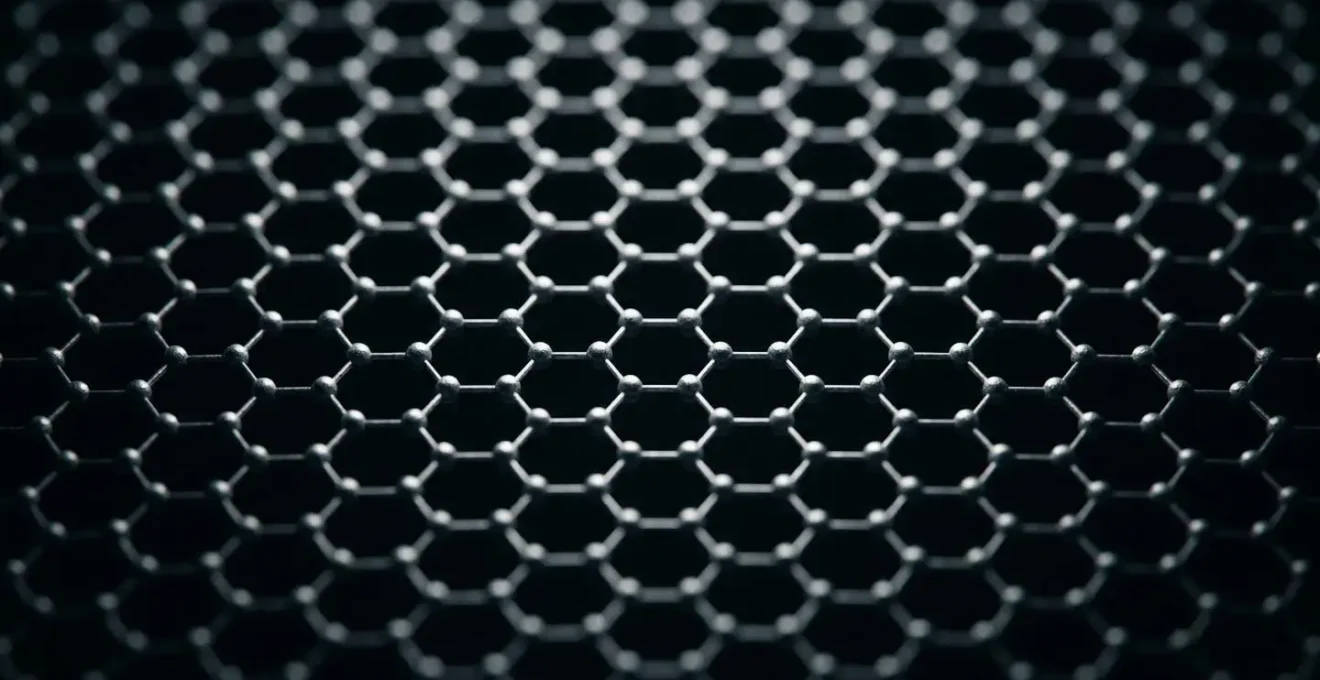
Polycrystalline graphene, which is composed of many small, perfect crystal domains, is far more common and scalable. The boundaries between these domains—the atomic-scale defects—act as stress concentration points. A landmark analysis published in Nature Communications illustrated this dramatically: while a perfect single-atom-thick sheet of graphene could theoretically support a soccer ball, the real-world strength of polycrystalline graphene with grain boundary defects could only support a ping pong ball. This demonstrates a critical principle: the “weakest link” in a nanomaterial is not an atom, but an imperfection in the atomic arrangement. Therefore, the commercial challenge isn’t merely making graphene, but controlling the nature and density of these “useful imperfections” to achieve a consistent, predictable, and economically viable level of performance.
How to Choose Between SEM and TEM for Atomic Level Imaging?
Once we accept that controlling atomic structure is paramount, the next question becomes a practical one: how do we see it? The two most powerful tools at our disposal are the Scanning Electron Microscope (SEM) and the Transmission Electron Microscope (TEM). Choosing between them is not a simple technical preference; it is a strategic decision dictated by the specific question you are trying to answer and the commercial context of your research. An SEM scans a sample’s surface with a focused beam of electrons, providing detailed information about its topography and composition. It excels at answering the question, “How does it look on the surface?” or “How did it break?”. In contrast, a TEM passes a broad beam of electrons *through* an ultra-thin sample, creating an image of its internal structure, including the crystal lattice and atomic arrangement. It answers the question, “Why is it so strong?” or “What is its internal atomic configuration?”.
The decision framework extends beyond the technical application into critical commercial considerations. A TEM can offer sub-50 picometer resolution, allowing us to visualise individual atoms, but this power comes at a significant cost. According to industry pricing data, TEM systems can cost between $500,000 and $1.5 million, with complex sample preparation and higher operational costs. SEMs are comparatively more accessible. This financial reality means that for routine quality control or failure analysis, the SEM is often the more pragmatic choice. The choice is a classic trade-off between depth of information and cost-effectiveness.
The following table, based on a framework from Thermo Fisher Scientific, provides a clear decision matrix for researchers and engineers navigating this choice. It reframes the decision away from “which is better?” to “which is the right tool for this specific commercial or research objective?”.
| Decision Factor | SEM (Surface Analysis) | TEM (Internal Structure) |
|---|---|---|
| Primary Information | Surface topology & composition | Internal structure & crystal lattice |
| Resolution | ~0.5 nm limit | Sub-50 pm with aberration correction |
| Sample Preparation | Minimal, can be non-destructive | Ultra-thin sections required (complex) |
| Research Question | “How does it break?” (failure analysis) | “Why is it so strong?” (atomic bonding) |
| Cost per Hour | 80% cheaper for industrial QC | Higher operational cost |
| Typical Use | Quality control, surface defects | Fundamental research, atomic-scale |
Lab Wonder vs Market Reality: Which Atomic Structures Scale Successfully?
The journey from a laboratory curiosity to a market-dominant material is littered with innovations that possessed breathtaking atomic properties but failed the test of economic scalability. The key differentiator is often not the perfection of the atomic structure itself, but the ability to produce a ‘consistently imperfect’ structure cheaply and reliably. This is a profound shift in mindset from pure science to applied engineering. As Simon Billinge of Columbia University and Brookhaven National Laboratory astutely noted, while “beautiful pictures of nanostructures capture the imagination… a table, filled with accurate atomic coordinates, is worth 1,000 pictures.” Investors and manufacturing partners are not swayed by a single heroic result; they require robust statistical process control and proof of reproducibility, which can only come from quantifiable atomic-level data.
beautiful pictures of nanostructures capture the imagination, but if a picture is worth 1,000 words, then a table, filled with accurate atomic coordinates, is worth 1,000 pictures
– Simon Billinge, Columbia University and Brookhaven National Laboratory
The history of carbon nanotubes (CNTs) provides a powerful case study. The initial excitement for using CNTs in composites was immense due to their extraordinary individual strength. However, early commercialisation efforts largely failed. The reason was a lack of atomic-level controllability during mass production. Critical variables such as chirality (the ‘twist’ of the atomic lattice), length, and the tendency for nanotubes to clump together (agglomeration) could not be controlled at scale. A batch of CNTs would contain a wide, unpredictable mix of types, leading to inconsistent performance in the final composite material. Research eventually showed that for commercial success, achieving a ‘consistently imperfect’ but predictable structure was far more important than chasing the perfect atomic arrangement of a single, ideal nanotube.
This principle is a cornerstone of modern material commercialisation. Success is not defined by the most flawless material created in a lab. It is defined by the atomic structure that delivers the required performance (“good enough”) while being robust to the variations inherent in large-scale manufacturing. The focus shifts from demonstrating peak performance once, to guaranteeing average performance a million times over. This requires an intimate understanding of which atomic-scale variations affect the final product’s properties and which are benign—a task for which advanced characterisation is indispensable.
The Atomic Defect That Causes Catastrophic Failure in Aerospace Alloys
While some atomic imperfections can be managed or even prove useful, others are drivers of catastrophic failure, particularly in high-stakes industries like aerospace. The phenomenon of hydrogen embrittlement in high-strength alloys is a stark reminder of this reality. This insidious process occurs when individual hydrogen atoms, often introduced during manufacturing or electroplating processes, migrate through the metal’s crystal lattice. They are small enough to diffuse easily, but their effect is devastating. The atoms tend to accumulate at stress-intensive areas, such as the boundaries between the microscopic crystal grains that make up the alloy, or at the tip of a micro-crack.
The consequences of this atomic-level infiltration are severe. As research in Nature demonstrates, the co-segregation of hydrogen atoms at grain boundaries can cause ‘decohesion’—effectively un-gluing the crystal structure from within. This dramatically reduces the energy required for a crack to propagate, causing the typically ductile and tough metal to fail in a brittle, sudden, and catastrophic manner at stress levels far below its design limits. It’s the ultimate Trojan horse at the atomic scale: an invisible impurity that brings down the entire structure.

This is not a theoretical concern. A review of recent aviation incidents highlighted how hydrogen embrittlement has been traced to failures in critical components like helicopter drive systems and aircraft crankshaft bolts. These events led to Airworthiness Directives mandating stricter manufacturing controls, including crucial post-processing dehydrogenation treatments (baking processes that drive out trapped hydrogen). This underscores the vital role of atomic structure analysis in ensuring safety and reliability. It is not enough to design a strong alloy; one must also design and rigorously control the manufacturing process to prevent the introduction of these fatal, atomic-scale defects. For the aerospace industry, the ability to detect and control these specific imperfections is not a matter of performance, but of survival.
When Will Atomic Manufacturing Replace Traditional Methods in the UK?
The vision of ‘atomic manufacturing’—building products atom-by-atom from the ground up—often conjures images of replacing traditional factories entirely. However, the current reality, particularly within the UK’s advanced manufacturing sector, is more nuanced and strategic. Rather than a wholesale replacement, techniques like Atomic Layer Deposition (ALD) are being deployed as a high-value finishing step that enhances, rather than supplants, existing processes. ALD is a process that builds up material one atomic layer at a time, offering unparalleled precision. As a research team at the University of York notes, ALD provides “better control over thickness, composition and quality than other thin film deposition techniques.” This control is the key to its commercial value.
A prime example of this strategy is the work being done at the UK’s Centre for Process Innovation (CPI). In 2019, CPI deployed a world-leading roll-to-roll ALD system, not to build flexible screens from scratch, but to apply an ultra-thin, perfectly uniform encapsulation layer onto them. For flexible electronics like OLED displays, the greatest enemy is moisture and oxygen, which can quickly degrade the organic materials. A traditional polymer substrate might be manufactured using conventional, cost-effective methods, but it lacks the necessary barrier properties. This is where ALD provides the crucial enhancement. By depositing a nanoscopically thin but perfectly dense layer of metal oxide, CPI creates an ultra-barrier that protects the sensitive electronics, dramatically increasing the product’s lifespan and reliability.
This case study illustrates the most viable path to market for atomic manufacturing in the near future. It is not about replacing the billion-dollar infrastructure of traditional manufacturing. It is about identifying the highest-value point in a production chain where atomic-level precision can solve a critical problem that traditional methods cannot. Atomic manufacturing serves as the final, perfecting touch—the enabling technology that makes an entire product viable. So, the question is not “when will it replace?”, but “where can it add the most value right now?”. In the UK, the answer is increasingly found in these hybrid manufacturing approaches.
Spectroscopy vs Chromatography: Which Is Best for Rapid Quality Control?
In the context of commercialisation, the speed and accuracy of quality control (QC) are as important as the production process itself. For materials whose properties are defined at the atomic or molecular level, two classes of techniques are paramount: spectroscopy and chromatography. A common question is which to choose, but the strategic answer is not to choose one *over* the other, but to deploy them intelligently in a complementary workflow. Spectroscopy (like Raman or Near-Infrared) is exceptionally fast. It works by shining light on a sample and analysing the light that is scattered or absorbed. This provides a unique “spectral fingerprint” of the material’s chemical composition. Its key advantage is speed and the fact that it is non-destructive—it can even analyse a product through its packaging. This makes it ideal for in-line, 100% screening on a production line.
Chromatography (like HPLC), on the other hand, is the gold standard for separation and quantification. It physically separates the components of a mixture and measures each one with high precision. However, it is slower, more expensive per sample, and destructive. It provides definitive, legally defensible data but is not feasible for screening every single item coming off a production line. The visionary approach to QC, therefore, is to pair them. Spectroscopy acts as the rapid, first-line defence, using AI-driven chemometric models to instantly pass conforming products and flag any that deviate from the expected spectral fingerprint. These flagged batches are then taken offline for a full, forensic investigation using chromatography to determine the exact nature and quantity of the contaminant or deviation. This two-tiered system leverages the strength of both techniques: the speed of spectroscopy for efficiency and the precision of chromatography for certainty.
Your Action Plan: Strategic Pairing Workflow for Quality Control
- Deploy spectroscopy (Raman, NIR) for instant in-line pass/fail screening on the production line.
- Train chemometric AI models to recognise the spectral fingerprints of conforming products.
- Flag any non-conforming batches for definitive offline High-Performance Liquid Chromatography (HPLC) certification.
- Use chromatography for forensic investigation and root cause analysis when spectroscopic screening fails.
- Leverage the non-destructive advantage of spectroscopy for through-packaging analysis and final product verification.
3D Printing vs CNC Machining: Which Is Best for MVP Speed?
The speed at which a Minimum Viable Product (MVP) can be created and tested is a critical factor in the commercialisation of any innovation. For physical products, the two dominant rapid prototyping technologies are 3D printing (Additive Manufacturing) and CNC machining (Subtractive Manufacturing). Asking which is “best” for speed is the wrong question. The right question is: what is the most critical question about my MVP that I need to answer *right now*? The choice of technology depends entirely on whether your primary test is about geometry and ergonomics or about material properties and performance.
3D printing, especially with polymers like PLA or resin, is unparalleled for iterating on form, fit, and feel. A design engineer can model a part in CAD in the morning, have a desktop printer produce it by the afternoon, and test its ergonomics that same day. This allows for daily design cycles, perfect for validating user interaction or ensuring components fit together in a complex assembly. It answers the question, “Does it have the right shape and feel?”. However, these polymer prototypes typically do not have the same mechanical properties as the final production material. They cannot be used to validate strength, fatigue life, or performance under load.
This is where CNC machining excels. It starts with a solid block of the final production material—be it aerospace-grade aluminium or a specific engineering polymer—and carves away material to create the part. While the setup and machining time can be longer (days rather than hours), the resulting prototype has the exact material properties of the final product. This allows for immediate, meaningful performance testing. It answers the question, “Will it be strong enough?”. The strategic path to an MVP often involves using both: initial rapid iterations with 3D printing to finalise the design, followed by a CNC-machined prototype for final performance validation before committing to expensive production tooling.
| MVP Testing Goal | 3D Printing (Geometry Focus) | CNC Machining (Properties Focus) |
|---|---|---|
| Primary Test | Form, fit, ergonomics | Strength, tolerance, material performance |
| Material | Polymer prototypes (PLA, ABS, resin) | Final production material (metals, composites) |
| Print/Machine Time | Faster print (hours) | Longer setup + machining (days) |
| Post-Processing | Requires support removal, sanding, painting | Minimal finishing on precision parts |
| Daily Iteration | Desktop printer enables daily changes | Weekly cycles for functional testing |
| CAD Requirements | Design for Additive Manufacturing optimization needed | Conventional CAD, simpler constraints |
| Total Time-to-Answer | Fast for design validation | Fast for performance validation |
Key Takeaways
- Control imperfections, don’t just eliminate them: Commercial success comes from producing a ‘consistently imperfect’ but reliable material, not a theoretically flawless one.
- Characterisation is for commercial proof: The primary role of techniques like TEM and spectroscopy in industry is to generate the quantifiable, repeatable data that de-risks investment and enables scaling.
- Nanotech as a high-value enhancement: The most immediate path to market is often not replacing traditional methods, but enhancing them at a critical point, like using ALD for encapsulation.
From Lab to Market: How to Commercialise Innovative Prototypes in London?
Translating a groundbreaking prototype from a London laboratory into a commercially successful product requires a clear, strategic pathway that leverages the UK’s unique innovation ecosystem. This journey is less a single leap and more a series of deliberate steps designed to build a comprehensive package of evidence. As the London Centre for Nanotechnology (LCN) states, its purpose is to “solve global problems… through the application of nanoscience and nanotechnology.” The key to this application is proving that an innovation is not just a “happy accident” but a controllable, reproducible, and scalable process. This is the essence of de-risking for investors and industrial partners.
The pathway begins with rigorous characterisation. Innovators can access world-class equipment at facilities like the LCN on a pay-per-use basis to generate the initial TEM images, AFM scans, and spectroscopic data. The goal here is to move beyond a single “hero” result and generate robust data on reproducibility. The next logical step is to engage with the UK’s Catapult centres. These organisations are specifically designed to bridge the gap between academia and industry, providing the pilot-scale facilities needed to validate manufacturing processes and begin scale-up trials. This demonstrates that the innovation can escape the confines of a lab beaker.
With this process data in hand, obtaining validation from an institution like the National Physical Laboratory (NPL) provides an unimpeachable stamp of technical credibility. This entire body of evidence—the atomic-level TEM images, the spectroscopic process data, the scale-up trial results, and the NPL validation—forms the core of an investor pitch deck. It’s a narrative built on data, proving not just that the innovation works, but that its creators have absolute, atomic-level control over *why* it works. This culminates in a multi-layered IP strategy, patenting not just the final material, but the characterisation methods and process parameters that guarantee its unique properties.
The imperative for the next generation of researchers and innovators in the UK is clear: think like a strategist. Master the tools of atomic analysis not merely to discover, but to control, to prove, and to build the compelling, data-driven case for investment that will transform UK science into global market leadership.